


Contemporary Community Textile Artist Derbyshire UK
Collaboration Kindness Carbon Sensitivity
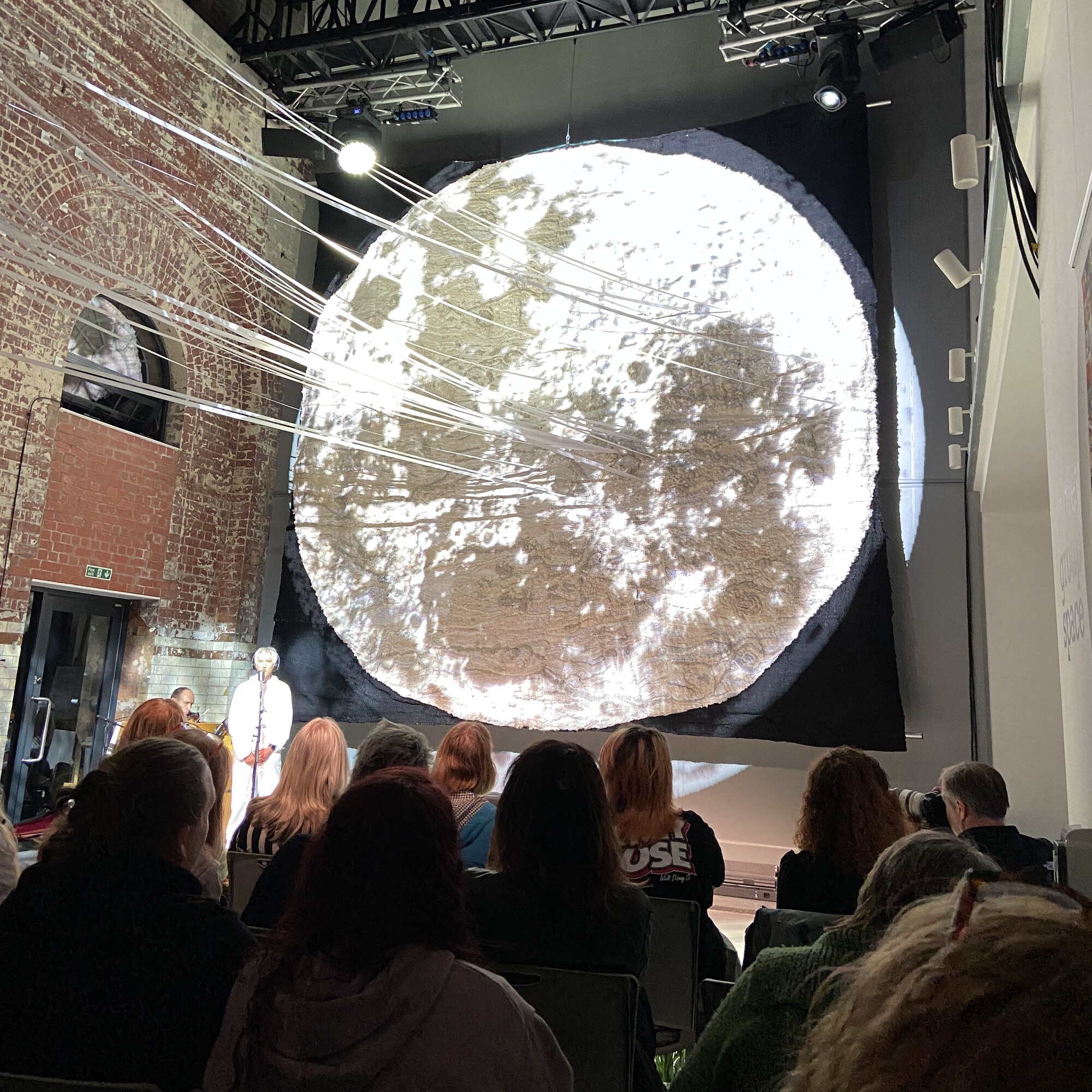

The Brightest Moon
Daimler Powerhouse
Weaving One Square Of A Six-Metre Moon For Coventry’s Daimler Powerhouse
Period
June To August 2021
My Role
Assistant Maker & Community Weaver
Project Type
Collaborative Project
Location
Daimler Powerhouse, Radford, Coventry, West Midlands, UK
Project Overview
In the summer of 2021 I wove one square of The Brightest Moon at home, then helped join the squares by hand and hoist the finished moon onto the wall of the Daimler Powerhouse in Coventry. The six-metre moon was made by community weavers from across the city to open the Powerhouse in August 2021, during Coventry’s year as UK City of Culture, and it recreated the moon that shone over Coventry on the night of the Blitz.
I was credited as Assistant Maker to Ali Ravenhall, who designed the woven moon and was its principal maker, on a commission Imagineer gave to Midlands-based artist Jean Baynham. Helping to weave and construct the moon was one of my proudest moments, and it was the biggest thing I had ever created.
Why Was The Moon So Bright On The Night Of The Coventry Blitz?
The moon we were recreating was the one above Coventry on 14 November 1940. It was almost full, and the Luftwaffe raid that night, code-named Moonlight Sonata, was planned around it, after an Enigma decrypt pointed to the next full moon, on 15 November. Coventry City Council’s account of the raid describes a night so bright that traffic could move without lights, and Marcus Sadler, writing to his father from Gibbet Hill Road, called it ‘the brightest moon I have ever seen’.
The fire at the city’s Daimler works that night was one of the largest of the war in Britain. The works at Radford had been Britain’s first car factory, where the first Daimler car was built in 1897, and that night’s bombing destroyed most of it. Only the Powerhouse and the office block on Sandy Lane survived, so our moon would hang inside one of the last pieces of the factory that burned beneath it on the night of the Blitz. Buildings like this matter in Coventry: in 2025 research for the National Trust found that 55% of residents said local heritage and history made them proud to live there, more than the national figure. Before the Powerhouse opened as a creation centre, Imagineer’s chief executive, Jane Hytch, explained that the team had found an original image of the moon from the night of the Blitz. They wanted to recreate it as a central installation that all the resident arts companies would feed into.
How Was The Brightest Moon Woven?
Imagineer called the making ‘a big weave’. Every community weaver had a frame loom a metre square, and each square was mapped to the moon’s real surface. The warp, the strings the weaving is built across, was marked with features such as craters, so it was a bit like weave by numbers. I wove my square at home, and by the evening of 15 July it was about half done. It was cream fleece and white fabric strips laid in waves, with a swirl at its centre where a crater was marked on the warp. When all the squares came together, the fleece, yarn and fabric strips ran from cream and white to fawn and pale lilac, with black around the outer edge.
The credits at the Powerhouse named 39 weavers and makers, me among them, alongside faith and community groups from Coventry and Nuneaton: the Black Churches Group, the Hindu Community of Coventry, the Muslim Community of Nuneaton, the Coventry Sikh Community, Ramgarhia Gurdwara, the Sikh ladies’ group Cha da Cup, Coventry SACRE and the Belgrade Friendship Group. Even the weaving frames were handmade, by Tony Ravenhall and Phil Tongue.
Raising The Brightest Moon In The Daimler Powerhouse
By 12 August the squares were laid out on the sprung dance floor upstairs at the Powerhouse. We sewed them into position by hand, kneeling on the woven structure as we worked. Each square was stitched to a backing with leather needles so the moon wouldn’t droop once it was hanging. On 23 August we rolled it up, carried it downstairs, fixed its top edge to a bar and hoisted it onto the vertical dance wall.
The Opening Weekend
More than 2,000 people visited the Daimler Powerhouse over the bank holiday weekend. The moon inspired evening performances on 28 and 29 August, choreographed by Louis Lewinson and Luka Owen. Ribbons stretched from it across the space, which Imagineer linked to Coventry’s ribbon-weaving past. A sign beside the moon explained that these lines left the weave in a Fibonacci spiral and carried on outside in digital form, as moonbeams travelling across the city over the 28 factory bomb strikes of that night, which visitors could see through an app on their phones.
Alongside Jean Baynham’s original concept, the work brought together digital art by Derek Lawrence, a soundscape by Dave Mills and Luke Weaver of Media Mania and lighting design by Arnim Friess, whose lighting turned it from a pale, cratered moon to deep red and purple. Some people told me it was the best event of the City of Culture year. When Claire Armitstead wrote about Coventry’s year in the Guardian, a table of diners asked for their favourite event so far named The Brightest Moon.
Connected Coventry Projects
The opening fell on the same weekend as Beneath The Trees, where on 28 August I spent the day building a phoenix banner with visitors in Naul’s Mill Park. Not long after, I joined the Herbert as Community Engagement Officer for Turner Prize 2021, which led to The Coventry Banner, my Turner Prize legacy project. My work with Imagineer continued the following year at Sanctuary in Bedworth, where I helped build David Best’s temporary memorial, produced by Artichoke in association with Imagineer.


