


Contemporary Community Textile Artist Derbyshire UK
Collaboration Kindness Carbon Sensitivity

The Herbert’s
Community Garden
A Shared City Garden Shaped Through Growing, Making & Local Heritage
Period
2022
My Role
Community Engagement Officer | Project Lead
Project Type
Community Project
Location
Herbert Art Gallery and Museum, Coventry
Project Overview
The Herbert's Community Garden in Coventry became a socially engaged project when it landed with me after a colleague left, with a lot still to decide and not much time before it was meant to be finished. I pulled together a small steering group and started with a practical question: what would make this community garden useful to people living in the city, especially those without outdoor space of their own? From there I worked with a garden designer, community partners and volunteers to turn an unfinished idea into a shared growing space.
Researching & Building Connections
Before we built anything, I went out to see what was already happening in Coventry. I visited the garden at Coventry Cathedral, the Weavers Cottage and other local growing spaces, partly to understand how they worked and partly to make connections. I was interested in the ordinary things that make a community garden usable: who looks after it, how people find their way in and what makes them feel that the space belongs to them too.
Creative Activity As A Way Into The Museum
Coventry Migrant Centre became one of the most important relationships in the project. I ran nature based sessions there using cooking, seed planting, seed balls, observational painting and natural dyeing with red cabbage onto fabric. Some of those activities then moved into the Herbert. Having something familiar and practical to do gave people a reason to cross the museum threshold without the pressure of feeling that they already had to know how a gallery worked.
People connected through Coventry Migrant Centre also came into the Herbert to make mosaic trials for the planned outside surfaces of the raised beds. A local artist developed a river design connected to the site and the well beneath the Herbert, while we explored the story of Coventry blue through the museum collection. The exact historic shade is uncertain, so rather than trying to reproduce it we used the surviving museum piece as a starting point for our own blue and white painted tile responses.
Building & Planting The Garden
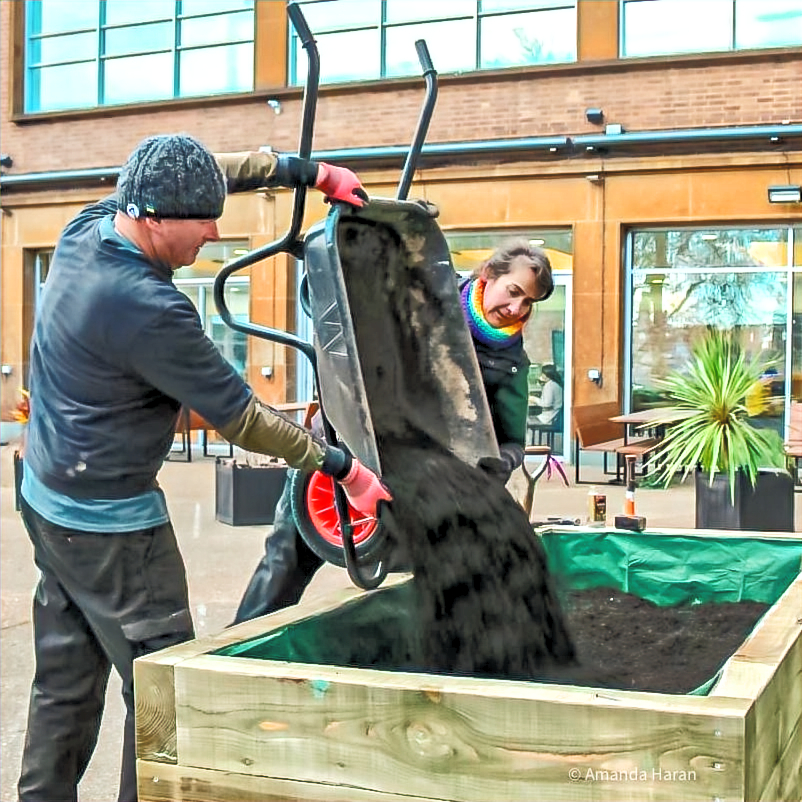
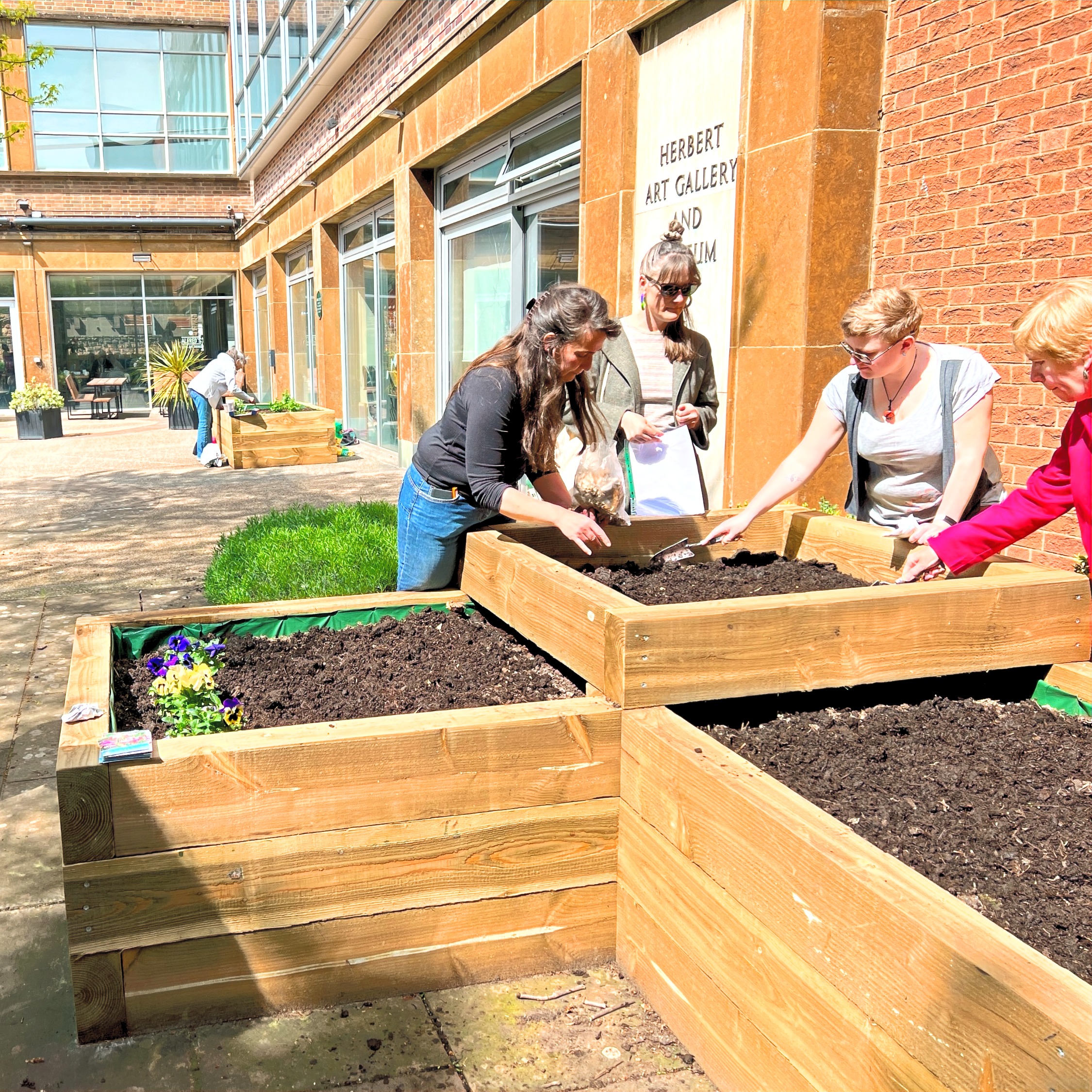
The raised beds were made through practical collaboration. Volunteers from a Men’s Shed and other groups helped with the build, and I was working alongside them rather than standing at the side directing it. I built beds, filled them with soil and planted the first season. That mattered to me because the garden needed to feel made with people from the start, not like a finished museum project that communities were invited into afterwards.
Reuse, Resourcefulness & Continuation
There was rarely much money around community projects, so reuse gradually became part of how I worked rather than an extra sustainability exercise added at the end. If something could be reused, borrowed, donated or adapted, that was usually where I started. In the garden activities we reused everyday containers for seed planting and growing, and that same habit of working carefully with what is already available has continued into my later practice. It sits within the wider sustainability thinking in my manifesto.
I also tried to think beyond the first season. I explored whether students from Coventry University next door might help care for the beds and began conversations with the Heritage Seed Library about possible future involvement. Those conversations had not developed before I left the Herbert, but they were part of trying to give the garden a life beyond its launch.
The garden brought together things that have become increasingly important in my practice since then: nature, making, local heritage, material resourcefulness and the use of creative activity to make unfamiliar cultural spaces feel easier to enter. By the time I left, the beds had been built, filled and planted for their first season, and the courtyard had started to become a shared growing place.
Related Work
The relationships and ways of working that shaped the garden had begun earlier through my Turner Prize 2021 community engagement at the Herbert, where access, trust and finding practical ways into the museum were already central to the work. The garden did not begin from scratch; it grew from relationships already built with people and organisations across Coventry.


