


Contemporary Community Textile Artist Derbyshire UK
Collaboration Kindness Carbon Sensitivity

Walking Forest
A Ten Year Artwork Linking Women, Trees, Suffrage History, Climate Action & Relationships That Continue Beyond The Public Performance
Period
2018 To 2028 | My Involvement Since 2021
My Role
Coventry Anchor Woman, Textile & Costume Contributor, Participant & Continuing Collaborator
Project Type
Collaborative Project
Location
Coventry, West Midlands & Charnwood Forest, Leicestershire, UK
Project Overview
Walking Forest is a ten year participatory environmental art project running from 2018 to 2028, led by Shelley Castle, Anne-Marie Culhane, Lucy Neal and Ruth Ben-Tovim. I joined the Coventry strand in 2021 as one of the Coventry Anchor Women, bringing textile making and collaborative practice into a wider artwork connecting women, trees, suffrage history and climate action. My role included planning, costume making and taking part in public actions in Coventry, while working with natural, recycled, found, borrowed and repurposed materials.
Applying To Join Walking Forest
Walking Forest came into my life in 2021 when I applied to be part of the Coventry group and was selected as one of the Coventry Anchor Women. It is a ten year participatory environmental artwork led by Shelley Castle, Anne-Marie Culhane, Lucy Neal and Ruth Ben-Tovim, bringing together women, trees, suffrage history, environmental action and collective making. I did not originate the wider artwork, and that distinction matters to me. My role grew inside an existing project through participation, textile knowledge, costume development and the relationships that followed. Walking Forest continues towards 2028.
There was already something in the idea that felt familiar. I had taken part in PROCESSIONS in 2018, when women and girls across the UK made and carried banners drawing on the history of women, textiles and public protest. Walking Forest was a different artwork, but that earlier experience had already shown me what could happen when women made together and physically carried ideas into public space. This time the natural world was part of the subject too.
Four Days In The Woods
The Coventry Walking Forest camp at Rough Close took place from 27 to 30 May 2021. The days were built around walking, listening, talking, eating and making together. We heard from women bringing very different kinds of knowledge into the woods, including environmental campaigners, historians and people working directly with climate justice. Zarah Sultana, then MP for Coventry South, addressed the group, and on the final day we stitched while listening to international environmental lawyer Farhana Yamin speak about the forthcoming COP26 climate negotiations.
This was also where I first began learning about mycelium and the idea of an underground forest network. Walking Forest uses mycelium as a way of thinking about human relationships as well as ecological ones. At the time I was not imagining that the idea would later reappear in my own work with soil and flax. I was simply taking in a great deal of information, including difficult conversations about ecological grief, environmental damage and responsibility. Sitting with those subjects in a woodland, surrounded by women who were prepared to talk about care as well as action, affected me deeply.
From PROCESSIONS To A Different Kind Of Procession
Looking back, PROCESSIONS and Walking Forest sit beside each other in my development. Both involved women occupying public space collectively and carrying ideas through a city, but Walking Forest brought trees, ecology and environmental responsibility into that language. The public action was not designed elsewhere and handed to us. The Coventry women worked with the Walking Forest artists to develop the route, choreography, costumes, props and actions. The Coventry City of Culture archive records that the production materials were, wherever possible, natural, recycled, found, borrowed or repurposed. That resourceful way of working felt very familiar to me and connects closely with the material decisions I continue to describe in my Manifesto.
Making For A Moving Forest
Lucy Neal suggested Rational Dress as a starting point for the costumes, and I worked with her to explore how that history could become something useful for Walking Forest. We were thinking very practically about what a woman might need during a long day of walking, carrying, performing and being outdoors. The garments needed room for sanitary products and other personal essentials, as well as water, food, tools and objects that mattered to the wearer. Comfort and independence were part of the design rather than an afterthought. The history of Rational Dress gave us a way to think about clothing, movement and women taking up space.
I became particularly interested in pockets. They solved a very ordinary problem, but I also liked the more subversive history they carried for women: having somewhere of your own to keep money, papers, tools or private things, and being able to move through the world without depending on somebody else to carry them. Pockets, work belts, divided garments and layers became part of a costume language that was practical, historical and quietly political at the same time. My textile knowledge was useful here, but the finished visual language belonged to a wider collaborative process rather than to one person.
Carrying The Birch Through Coventry
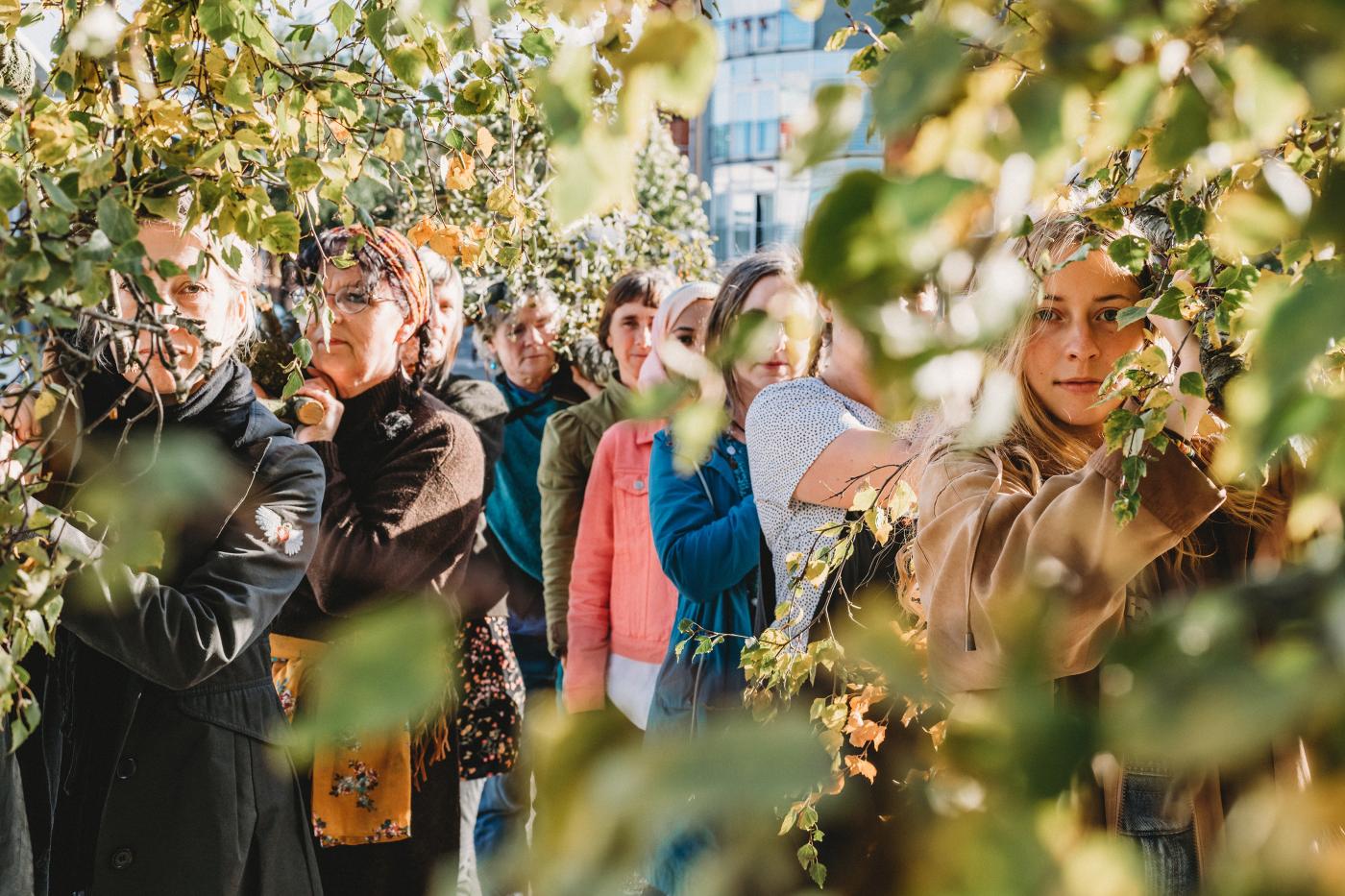
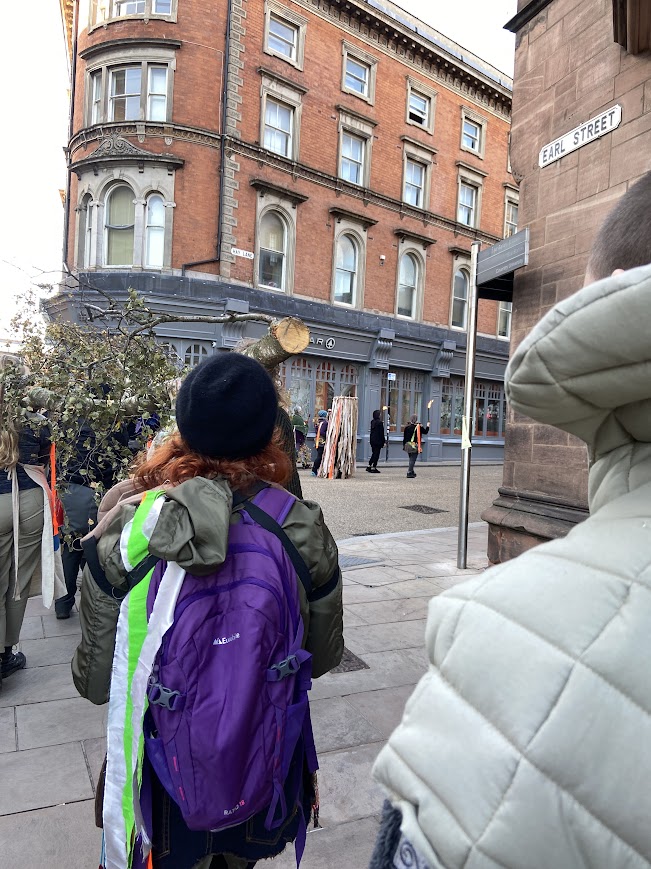
On 15 and 16 October 2021 the work moved into Coventry. From dawn until dusk, women carried a felled silver birch through the city in a two day performance action. The route created different kinds of encounters through movement, conversation, food, speaking and reflection. At the end of the first day the tree was carried into Coventry Cathedral ruins, where the action continued into an evening vigil. The official Coventry record documents the action and the Coventry women involved.
Carrying the tree mattered physically. It was not simply an environmental message placed beside us. We had to negotiate its weight with other bodies, listen to one another, move at the pace of the group and keep making small adjustments. The artwork depended on people being willing to carry something together. The birch was later laid down at Floyds Field, returning the tree to the ground and continuing the project’s thinking about living connections below the surface.
A Seed That Kept Growing
One of the smallest actions at Rough Close has turned into one of the longest lasting. I was given a seed connected to the Suffragette Tree story and planted it during the project. On the little label I wrote ‘Thank you Emmeline’. I still have the tree now, growing on my windowsill. I am deliberately not fixing a species name to it here because the important part for me is the living connection: something I planted during Walking Forest is still requiring care years later.
That feels entirely appropriate for an artwork concerned with what women inherit, protect and pass forward. A seed does not behave like a finished exhibition object. It grows slowly, unpredictably and only if somebody continues to look after it.
A Network That Continued
The public action was not the end of the Coventry group. The women have kept in touch, supporting one another, sharing information and opportunities and finding reasons to reconnect. I have come to understand that as part of the creative work itself. Making a connection once is rarely enough. Relationships need attention: returning, sharing something useful, making an introduction or simply continuing a conversation when the original project has moved on.
In March 2025 I joined another Walking Forest gathering at Martina Irwin’s Tree Sanctuary at Shilton Lane Allotments in Coventry. Martina was also one of the Coventry Anchor Women, and meeting again in a place shaped by care for rescued trees made the continuing relationship feel very tangible.
Returning To The Forest
In June 2025 I returned to Walking Forest through its Creative Camp at The Outwoods in Charnwood Forest, Leicestershire. The National Forest supported the camp as part of its 2025 arts programme. I was the only woman from the original Coventry group who attended that particular gathering. That did not make me a representative for everybody else, but it made the continuity visible. Four years after applying to join Walking Forest, I was still choosing to return.
What Travelled Into My Own Practice
Some of Walking Forest’s influence only became visible later. While undertaking learning in nature connectedness through the University of Derby, I found myself returning to the questions raised in those woodland days. The mycelium learning travelled too. When I began working more deeply with soil and mycelium through my Derbyshire flax work, I was again thinking about underground networks, mutual support and what happens when soil is treated as a living system rather than simply something that produces a crop.
Walking Forest also helped me recognise a form of environmental action I later described as gentle protest. It does not mean avoiding difficult subjects. For me it means finding routes into them through making, walking, conversation, shared experience and care rather than assuming confrontation is the only form action can take. That thinking now sits underneath much of my community practice, including the way I approach my flax work in Derbyshire.
Towards 2028
Walking Forest is still unfolding. Its ten year journey is developing towards an intentional woodland in 2028, drawing on the history of the Suffragette Arboretum and continuing the relationship between women, trees and public action. The year will also mark one hundred years since the Equal Franchise Act 1928, when women gained voting rights on the same terms as men.
My part began much more simply: I saw an invitation, applied and was selected. What followed brought together women’s history, textiles, public action, ecology, reused materials, grief, friendship and learning about the unseen networks beneath our feet. I could not have known in 2021 that some of those ideas would later find their way into a front garden in Derbyshire where I was growing flax and learning how to look after damaged soil. That is one of the reasons I no longer think of projects only by what we made at the time. Sometimes the most important material arrives years later.


