


Contemporary Community Textile Artist Derbyshire UK
Collaboration Kindness Carbon Sensitivity

Abundance
Carnival Of Lights
Women’s Stitched Voices Carried Through Coventry In Light, Cloth & Changing Forms
Period
2021
My Role
Lead Artist & Facilitator
Project Type
Community Project
Location
Foleshill, Coventry, West Midlands
Project Overview
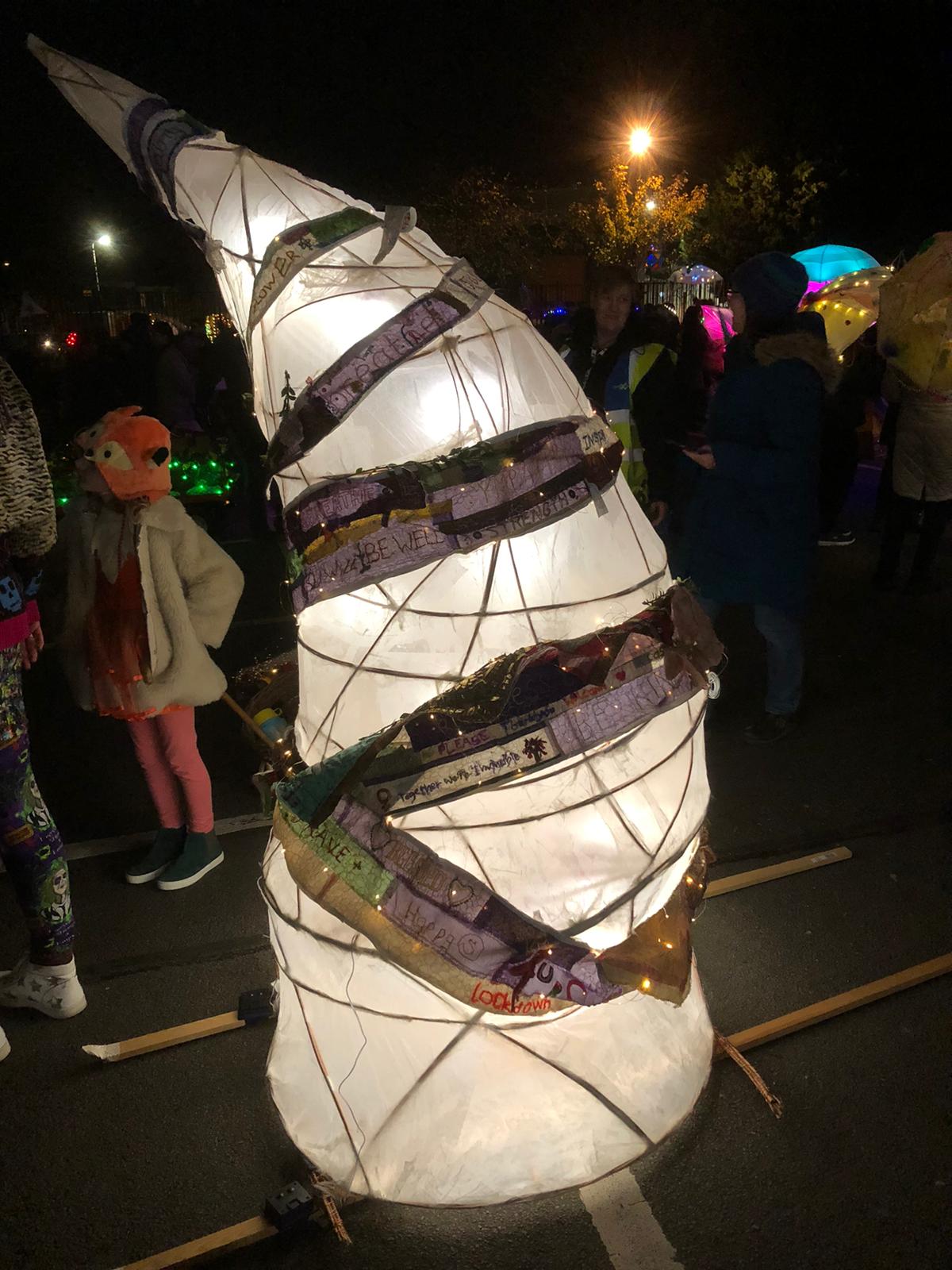
Abundance | Carnival Of Lights was a 2021 community textile and lantern project in Foleshill, Coventry, developed from Sew What? and carried into Coventry UK City of Culture. More than 100 women and girls had contributed stitched clooties, while more than 50 women had also stitched advice squares that I had assembled into a quilted banner. For the Abundance procession on 7 November 2021, I transformed the returned clooties into long ribbons around a large illuminated lotus lantern and remade the quilted banner as the Coat of Kindness so both sets of women’s words could travel through the streets.
The public event drew an estimated audience of around 6,000 people, but moving intimate hand stitched contributions into a city scale procession changed the making. Willow, paper, lighting, weather, safety, transport, storage and labour all shaped the final work. Looking back, those pressures became an important point in how I came to understand community artist burnout, invisible labour and the need for clearer boundaries around collaborative work.
The clootie strand grew from Sew What?, while the advice squares continued through Advice To Your 15-Year-Old Self. This page focuses on the moment when both strands entered Abundance and on what that scale asked of the work and of me.
The Ribbons Came First
The lantern was not the starting point. It began with Sew What?, an Arts Council England supported project made during Covid in which more than 100 women and girls stitched words they had longed to hear onto cloth ribbons. Some of the fabric came from repurposed PROCESSIONS suffrage sashes donated by Artichoke. The ribbons already carried individual voices, women’s history and the physical evidence of many hands before the idea of a lantern appeared.
While I was developing Sew What? I bought a book about Judy Chicago’s The Dinner Party. I kept going back to the way she had used textile, embroidery and forms of making so often associated with women’s domestic lives to give women’s stories a monumental public presence. I was not trying to recreate The Dinner Party, but it gave me permission to think about what might happen when many individual women’s contributions were brought together without losing the person behind each one. That thinking sits underneath the ribbons, the stitched squares and my wish to carry them into public space.
I loved the ribbons as they were. They were tender, uneven, direct and full of personality, and I wanted people to see them rather than letting them disappear at the end of a participatory project. PROCESSIONS had already shown me the power of women carrying textile messages through public space. When an opportunity connected with Coventry’s Carnival of Lights appeared, I began wondering whether the ribbons could travel again in a new form.
From Ribbon To Lotus
My proposal was a lantern shaped like a single lotus petal. During Covid I had taken part in an online Madhubani drawing workshop and had become attached to the image of the lotus, a flower I understood personally as something able to emerge from mud. I imagined the stitched ribbons wrapping around a petal shaped structure while light shone through them, illuminating the women’s words rather than hiding them.
I began making small prototypes at King Edward VI College, where I had previously been Artist in Residence. One of those early models can be seen on my studio desk in photographs from the period. The project then changed scale. For a public parade the lantern needed presence, and it was suggested that I make it as large as possible. That decision altered almost every practical and visual choice that followed.
Learning A New Material Language
Construction continued in the garden at home. I was learning how willow structures behaved, how paper could skin and strengthen a lantern, and how a textile idea might survive when translated into a much larger three dimensional form. I sewed the individual ribbons together into long strips so they could travel around the framework. I had hoped the stitched cloth would cover much more of the structure, but as the lantern grew there was simply not enough ribbon for the scale we had reached, so the paper became more visually dominant than I had originally intended.
The lighting created another layer of design. The lights supplied for the parade needed an anchor point inside the lantern, access so they could be switched on, and a way of being retrieved afterwards because they had to be returned. The structure therefore could not simply be sealed and treated as a permanent sculpture. Its eventual dismantling was already built into the making.
Scale also changed the logistics. The lantern became too large for a car and needed a hired van. It travelled to the venue in two sections and was assembled there at full height. I understand these things differently now. Transport, storage, access, labour, budget and the route an artwork takes into and out of a venue are not problems that sit outside the art. They shape what can be made, how well it can be made and what the artist is able to carry.
Seen Before It Was Finished
Before the November procession, the lantern had another public life. While it was still incomplete it was shown at The Risers at The BOX, FarGo Village. In those photographs the willow structure is still visibly in progress and the balance between paper, ribbon and framework has not yet reached its later form. That unfinished appearance is now useful evidence of how the work developed rather than something that needs to be tidied away.
The Risers also makes the overlapping nature of my Coventry practice visible. The lantern was moving between a participatory textile project, a grassroots artists’ exhibition and a future city procession rather than belonging neatly to one place. I was increasingly working through relationships that crossed institutions, community groups, artist networks and public events, and the edges between projects were rarely as clean as an archive makes them look.
The Quilt That Became A Coat
A second strand of Sew What? was travelling towards the procession at the same time. More than 50 women had stitched fabric squares carrying advice they would give to their younger selves. I had spent weeks constructing those individual pieces by hand into a large quilted banner on repurposed curtain fabric. I wanted that collective textile to move through the streets too, because its scale allowed the women’s messages to sit together with real visual weight.
The banner could not be carried in that form because its size created a potential wind risk in the procession. Public events need safety planning, and that requirement was understandable, but artistically it meant taking apart a finished piece that had required weeks of labour. The same women’s work would have to find another body.
When the quilt could no longer be carried safely in its original form, it was dismantled and reworked as the Coat of Kindness. A colleague took the lead in remaking it, using the stitched pieces to create a wearable form that could move through the procession. The women’s words remained present, but the work had changed again in response to the practical conditions around it.
The Coat of Kindness was worn ahead of the lantern during the procession. For me it never had quite the same visual gravitas as the full banner would have had in the street, and I still recognise that loss. But remaking it meant the women’s stitched messages were not excluded from the event. They travelled through Coventry on a body, while the clootie ribbons followed behind as part of the illuminated lotus structure. The two works became different ways of trying to keep women’s words visible while adapting to the conditions around them.
Abundance | Carnival Of Lights
The final procession took place in Foleshill on 7 November 2021 as Abundance, following the earlier Carnival of Lights. Coventry City of Culture described the event as a celebration of light, hope and freedom, with its City of Hope theme explicitly concerned with unity and female voices. That matters to this project because the textile pieces were not symbolic stand ins for women’s voices. They contained words women had chosen and stitched for themselves.
The later Love Coventry evaluation estimated an audience of around 6,000 people for Abundance and recorded the scale and organisational complexity of making a large public event through community participation. The evaluation helps me understand my own experience in a wider context. Moving intimate community made work into a city scale procession brought requirements around weather, safety, movement, lighting, access and spectacle that inevitably changed what the work could be.
The women did speak. Their words existed before the parade and remained theirs. What changed repeatedly was the form through which those words could be seen. The ribbons became long textile strips around a lantern. The lotus petal became much larger than the first prototypes. Paper took up more of the surface. A quilted banner became a coat. The lighting affected the structure. Transport affected the scale at which the work could move. None of those decisions can be separated completely from the final appearance.
Voice, Scale & Compromise
Looking back, there is an uncomfortable irony in making work intended to give women space to speak while repeatedly adapting that work to fit the structures around it. I do not read that as a simple story of an institution silencing people. A large public procession has responsibilities that a small studio project does not. What interests me is the tension itself: how easily an intimate contribution can change once it enters a larger system, and how much labour can be required to keep the original voice present.
At the time I was willing to solve almost every problem by making again. If something did not fit, I altered it. If a finished textile could not travel as a banner, I took it apart and made a coat. If the lantern needed to be larger, I learnt new construction methods. If it would not fit in a car, I found a van. That resourcefulness is still part of my practice, but this project taught me that constant adaptation has a cost. Saying yes, finding another workaround and absorbing another piece of labour are not automatically the same as good collaboration.
Since then I have become much more deliberate about capacity, budget, transport, storage, access, materials and the life of an artwork after an event. Those questions now enter the artistic planning much earlier. Carnival of Lights is one of the projects that taught me why they have to.
What Survived
The illuminated lantern existed for one procession. Afterwards I dismantled the structure so the borrowed lights could be returned. I kept the women’s clootie ribbons. That ending feels significant now because the large public object disappeared while the smaller stitched contributions survived. The part I had most wanted to protect was still there.
The Coat of Kindness was temporary too. After the procession I took it apart and reconstructed the stitched squares back into the quilted work. I continued showing it because my aim had always been to spread the women’s messages beyond the people who had made them. The quilt was later exhibited at the Festival of Quilts at the NEC in Birmingham in 2023 and is now permanently displayed at the Marlene Reid Centre in Coalville. The changing forms were not the end of the work. They became part of how those words kept travelling.
The wider story of that textile can be followed through my Coat of Kindness and Choose To Challenge project. It sits beside the lantern rather than underneath it, because both came from the same desire to help women’s own words move into places where they could be encountered by people who had not been part of the original making.
Carrier Bag Thinking Came Later
I did not know Ursula K. Le Guin’s The Carrier Bag Theory of Fiction when I made this work. I encountered that thinking later, so it would be wrong to claim it as an influence on the 2021 design. What I can see now is that some of the concerns that later drew me towards carrier bag thinking were already forming here.
I was gathering, holding and carrying other people’s contributions rather than trying to replace them with one heroic statement of my own. The ribbons carried individual words. The quilt held many stitched squares together. The coat carried those pieces on a body. The lantern became another kind of container, carrying cloth and light through the city. Yet the project also taught me that a container can become so large, complicated or visually dominant that it starts to compete with what it was created to hold.
That question now runs through my community practice: how do I gather and carry other people’s stories without the structure around them becoming louder than what they have chosen to say? I did not have that language in 2021. Carnival of Lights helped create the conditions in which I would eventually need it.
A Turning Point In My Practice
I do not want to rewrite this project as an uncomplicated success because that would remove the lesson. The women’s contributions were beautiful and important. The public opportunity gave those contributions an audience they would not otherwise have reached. At the same time, the finished lantern did not resolve in the way I had first imagined, and getting it into the street demanded far more physical, emotional and practical labour than I had understood when I said yes.
The experience changed how I work. It helped me recognise the difference between an exciting opportunity and the right conditions for an artwork, between being adaptable and absorbing every difficulty myself, and between making something large and making something that gives its contents enough room to be heard. Those lessons appear again and again in the projects that followed.
This is why Carnival of Lights belongs in my archive in full rather than as a small photograph of a lantern. It records women’s stitched testimony, public procession, reuse, learning, compromise, visibility and a point where my practice began to understand its own limits as well as its possibilities. The object was temporary, but what I learnt from making, carrying and dismantling it has continued to shape the way I approach community work ever since.
Public Success & The Reality Behind It
Reading the Love Coventry evaluation years later changed how I understood this project. It estimated attendance at approximately 6,000 people, and the audience response to Abundance was extraordinarily positive. Among those surveyed, 99% said they had had a good time, 99% rated the event as good or very good, and 99% said it had increased their pride in Coventry. The same evaluation also records how demanding Abundance was to produce, particularly for a novice grassroots cohort, with wide ranging risk assessments, significant support needs and a great deal of time and energy involved in bringing community ideas into a large City of Culture event.
Finding that in the formal evaluation was unexpectedly emotional. For years I had mainly remembered the exhaustion, frustration and compromises of making the work, and I had assumed much of that difficulty belonged to me alone. The evaluation does not tell us that the makers as a whole were unhappy, and I do not want to claim that, but it does show that the process behind a joyful public event could be far more complicated than the finished procession suggested.
That matters to how I work now. Audience response is important, but it is not the only way I judge whether a participatory project has worked well. I also look at where the labour sits, whose ideas have had to change, whether people have enough support, whether the scale is realistic and whether the conditions around the work allow the original voices to remain clear. Abundance taught me to pay attention to what happens on both sides of a finished public event, including the parts the audience may never see.
There is an irony in returning to Judy Chicago through this experience. What first drew me to The Dinner Party was the power of bringing women’s individual contributions together and giving them public presence. Abundance did that too, but it also taught me something I had not properly understood at the beginning of my practice: care for contributors and care for the artwork also has to include care for the artist doing the carrying. That lesson has shaped the way I think about scale, responsibility, boundaries and invisible labour ever since.
Community Artist Burnout, Invisible Labour & Saying Yes
I did not have the language for community artist burnout at the time. I thought I simply needed to work harder, be more adaptable and keep saying yes. I was trying to build a career, I cared about the communities I was working with, and I wanted the projects around me to succeed, so when something was late, under resourced, unclear or simply did not work as planned, my instinct was usually to fill the gap myself. I kept finding another solution, another evening, another weekend and another piece of myself to give to the work.
Looking back, I can see how much invisible labour I was absorbing because I wanted the work, the women whose voices I was carrying and the wider opportunities around me to succeed. Some of that labour was practical and some of it was emotional, but all of it took time and energy. I was still learning that being caring and resourceful did not mean I had to make every problem mine, or use time that should have belonged to rest and family life to hold a project together. That understanding has become part of how I now think about sustainable community practice.
What I Wish I Had Known As An Early Career Artist
For a long time I thought the difficult feelings I carried from this project meant that I had somehow failed to cope with an important opportunity. Looking at it again years later, alongside the formal evaluation and the experiences later voiced by other grassroots creatives, I understand it differently. I was still learning where my responsibility as an artist ended and where the responsibility of the structures around a project began. I wish I had understood that distinction much earlier.
If you are near the beginning of an arts career and recognise some of yourself here, I hope this part of the story is useful. Being generous, adaptable and committed to other people does not mean absorbing every problem yourself. A project can look successful to an audience and still have asked too much of the people who made it. Asking about budget, time, transport, responsibilities, practical support and what happens when plans change does not make you less committed to the work. Those questions are part of making good work possible.
Revisiting this project has given the difficult parts somewhere useful to go. I can keep the public joy of the procession, the women’s stitched words and the things I learnt without pretending the process was easier than it was. The lantern disappeared after one night, but the women’s stitches remained, and so did the lessons.


