


Contemporary Community Textile Artist Derbyshire UK
Collaboration Kindness Carbon Sensitivity

The Risers
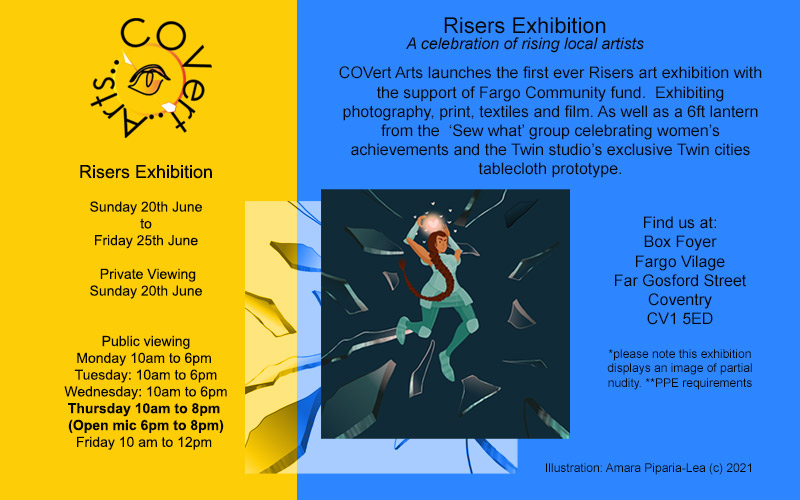
COVert Arts Exhibition
Where My Individual Textile & Community Practices Stood Together
Period
June 2021
My Role
Exhibiting Artist
Project Type
Exhibition | Installation
Location
The BOX, FarGo Village, Coventry
Project Overview
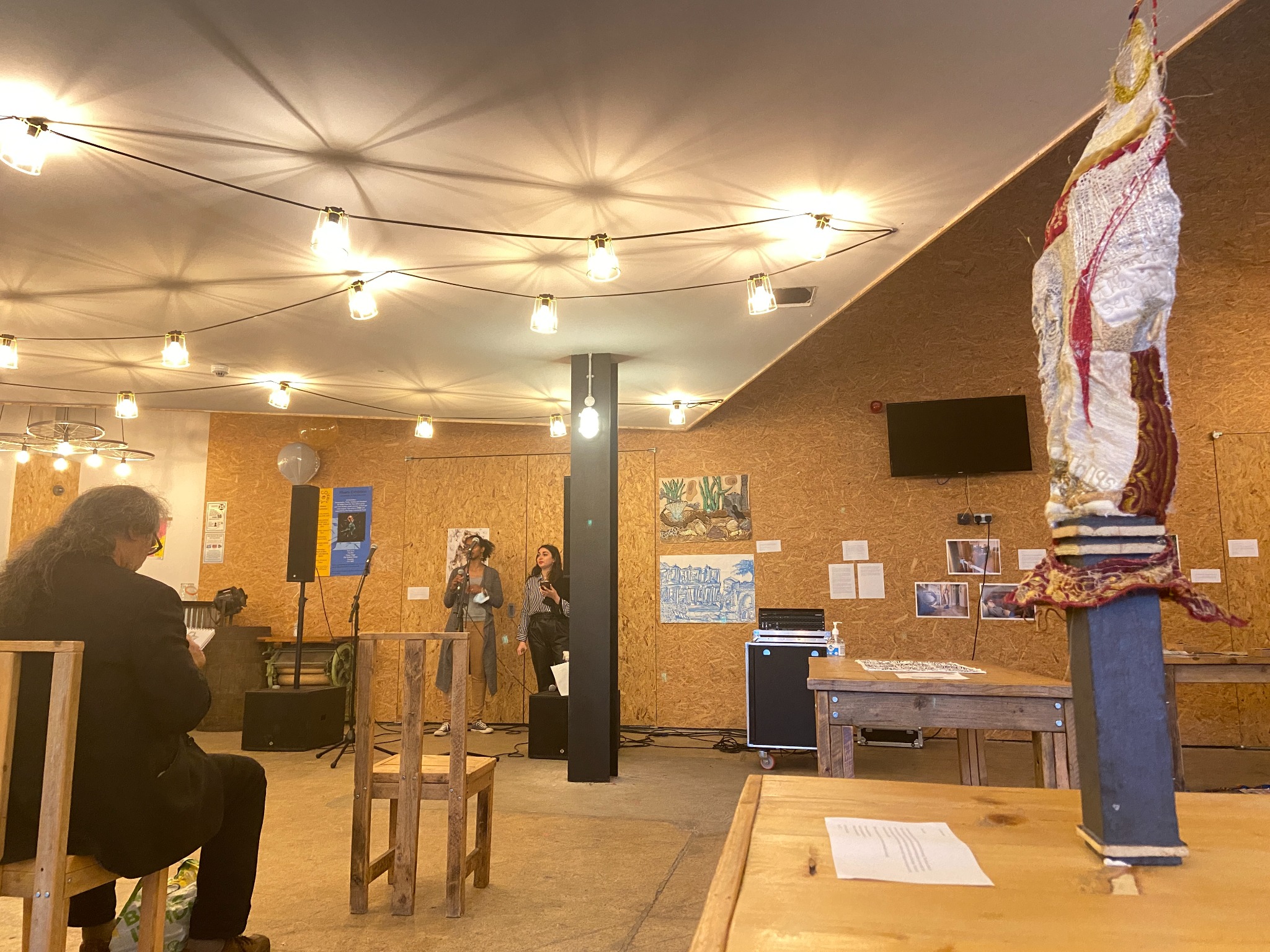
In 2021 I was selected as one of ten artists for The Risers, a COVert Arts exhibition at The BOX in FarGo Village, Coventry. I brought two works into the room that showed the two strands of practice I had been trying to keep alive through Covid. One was a textile sculpture developed from my experience of seeing the Book of Kells in Dublin just before lockdown. The other was an unfinished collaborative women’s lantern growing from an Arts Council England supported project made with stitched words, messages and cloth.
At the time I understood them as two sides of my practice, but looking back I can see that they also recorded two very different conditions of making. The Book of Kells work had given me somewhere to put fear and loneliness through a textile language I knew. The lantern was becoming a work made while I was carrying too many commitments, learning an unfamiliar construction process and dealing with practical pressures I had not thought through. At The Risers those two experiences stood beside one another.
The exhibition also caught something about how I was working in Coventry. I was employed by the Herbert, but I was becoming part of the city’s artist and community networks in my own right. Foleshill Creates, COVert Arts, The BOX, Walking Forest and artists I had already met elsewhere kept crossing through one another, so The Risers feels less like a neat standalone project and more like a place where several threads briefly became visible together.
Both Sides Of My Practice
During Covid I had made a conscious effort not to let either part of my practice disappear. My individual textile work still mattered to me, but so did the relationships and collaborative making that were becoming a much bigger part of my life in Coventry. The Risers was unusual because I did not have to arrive as one or the other. My Book of Kells textile sculpture and the unfinished lantern were allowed to stand in the same room.
That still feels important, but I understand the pairing differently now. Neither work was secondary to the other, yet they were not emotionally equivalent. One had grown slowly from a private experience of fear and a textile language I trusted. The other carried valuable contributions from women I had worked alongside, but the physical lantern was becoming bound up with pressure, unfamiliar making and decisions I had not planned strategically enough.
The Book Of Kells | Holding Uncertainty
I had been to Dublin shortly before lockdown and had seen the Book of Kells at Trinity College Dublin. When the world suddenly closed down I felt frightened and very alone, and that encounter found its way back into my making. I worked through drawing, layering and stitch, and stitched words from the Serenity Prayer into the sculpture because I needed its ideas of serenity, courage and wisdom at that point in my life.
The Book of Kells is extraordinarily intricate. Its pages can look exuberant and almost unruly, yet close study has revealed careful planning and symmetry underneath that complexity. Looking at my own work now, I can see why that matters to me. The surface could hold density, uncertainty and emotion because there was structure underneath it. Making the sculpture did not remove the fear of lockdown, but the slow familiarity of textile gave me a way to contain some of it.
Placed beside the lantern at The Risers, that difference is much clearer to me than it was in 2021. One work had helped me hold uncertainty, while the other was teaching me what happened when I was carrying too much of it.
A Lantern In Progress
The lantern had not been made for a gallery. I was building it for the Carnival of Lights in Foleshill through the Foleshill Creates network, using stitched pieces that had grown from my Arts Council England supported Covid project. While it was still being made, I was asked to show it at The Risers, so a work intended to be carried through the streets temporarily had to stand still inside The BOX.
I want to separate the women’s stitched contributions from my experience of the final object because the two are not the same thing. The ribbons mattered to me and I have kept them. The physical lantern became much more difficult. I had never made one before, I had agreed to a scale without thinking far enough ahead about what moving and storing it would involve, and it became too large to fit into a car. It needed a van, which I did not drive, and that transport had not been allowed for in the project budget, so I absorbed an additional cost myself.
By the time the lantern reached its later public form I was exhausted and unhappy with the quality of the object I had made. I do not want that feeling to erase the care contained in the stitched ribbons, but it changed the way I thought about public work. Scale, transport, storage, labour, budget and the capacity I actually had available all became part of the artistic planning rather than practical problems to solve afterwards. The photographs on this page deliberately keep the lantern at the unfinished Risers stage. Its later public life belongs to the Carnival of Lights story, while the earlier collaborative work can be followed through my Coventry Clootie Lantern project page.
I still have the ribbons and sometimes wonder whether they might one day be honoured in another form that feels quieter, more considered and more faithful to what the women contributed. There is no timetable for that. Keeping them is enough for now.
Inside & Outside The Institution
At the same time I was employed by the Herbert as Community Engagement Officer. That title can suggest a neat line between an institution and the people it is trying to reach, but my experience was much messier and more human. I spent time alongside groups, joined networks, made things with people and became part of Coventry’s creative life beyond the museum. I carried the responsibility and access that came with the Herbert, but the relationships were not simply routes back into the building.
At The Risers I was not there to represent the Herbert or to facilitate someone else’s participation. I was there because I was one of the artists. That inside and outside position became very clear to me there, and it also helps explain why so many of the relationships from this period reappear across other projects. The institutional strand of the same period can be followed through my Turner Prize 2021 community engagement project.
People & Places That Kept Reappearing
COVert Arts was a Coventry grassroots artists’ collective, and The Risers brought ten selected artists together at The BOX. Some of those artists were already part of my world. I had worked with Dr Seyedeh Naseriniaki on a community shopfront installation with migrant and refugee women before the exhibition, while COVert co founder Sherrie Edgar later reappears through Walking Forest and the Coventry Banner. The BOX itself came back into my practice when we developed Walking Forest uniforms there and first practised carrying the tree from the space.
Foleshill Creates was part of this too. I worked with the group and was a member, so I was not arriving in Foleshill as an outside artist who briefly dropped in. These relationships moved backwards and forwards between community work, exhibitions, city events and my job at the Herbert. The exhibition promotion also left a useful record of that moment in my practice: watch the COVert Arts video interview here.
A Practice Without Neat Edges
The longer I look back at Coventry, the less useful it feels to pretend these projects had clean beginnings and endings. The lantern moved from one context to another, artists disappeared from one project and reappeared in another, and the same places became exhibition rooms, rehearsal spaces and meeting points for completely different work. The Risers matters because several of those threads became visible in one room: individual textile work, community making, institutional life, grassroots artist networks and relationships that kept growing after the exhibition closed.
It also records a lesson I could not see clearly at the time. The Book of Kells sculpture showed what could happen when I had control over pace, scale and a material language I understood. The lantern showed me how quickly artistic quality and personal capacity could become compromised when the conditions around a project were not properly designed. Both belong in the archive. The overlaps, including the uncomfortable ones, are part of the story rather than something to tidy away.


