


Contemporary Community Textile Artist Derbyshire UK
Collaboration Kindness Carbon Sensitivity

Make/Shift Creative Agents | Creative Listener
Creative listening and participatory project evaluation for arts, heritage, cultural, community and place based programmes.
Period
2025 To 2026
My Role
Creative Listener
Project Type
Commission
Location
Amber Valley, Derbyshire
Project Overview
In 2025 I was invited to journey alongside Make/Shift and Platform Thirty1’s Neighbourhood Creative Agents programme in Amber Valley, Derbyshire, as a Creative Listener. I began by learning more about evaluation, then followed the work through Stephen Willats inspired diagrams and booklets, Derbyshire Supergirl, public testing at Open House, discarded photocopies and finally a small paper vessel. Each change came from listening to what the work and the people around it were telling me, rather than forcing the experience into numbers or a tidy story.
Where Creative Listening Began
Before the Make/Shift commission, I had already started questioning how community engagement was evaluated during Turner Prize 2021 at the Herbert Art Gallery & Museum. Attendance and participation figures mattered, but they could not show everything I was seeing: people returning, trust building, relationships developing and opportunities leading to other opportunities. When I was asked to reflect on the engagement work, a conventional written report did not feel enough. I drew a large map of community activity, relationships and possible legacy connections instead. It was presented to the Turner Prize judges and Arts Council England and was appreciated as a different way of communicating what the engagement work had actually looked like. I did not have the words ‘Creative Listening’ for this then. Looking back, it was an early form of the same enquiry: how might creative and participatory evaluation hold relationships, lived experience and learning alongside the numbers?
Listening Before Measuring
After taking on the role, I attended the Nature Connectedness Conference at Derby’s Museum of Making because I wanted to learn more about evaluation before deciding what creative listening might become. Neighbourhood Creative Agents is a community led programme in Amber Valley, developed by Make/Shift with Platform Thirty1. My position sat alongside the Agents rather than inside their neighbourhood projects. I was interested in the experience of being a Creative Agent: how people held the voices of their communities, worked with uncertainty, made decisions and carried responsibility in the places where they lived. That left me paying attention to more than whether a community project had succeeded. I wanted to notice what it felt like to do the work, what was changing between people and what might disappear if I only looked for tidy outcomes.
Following Stephen Willats
I began looking for ways to give that listening some structure. The work of Stephen Willats became an important reference point, particularly his use of diagrams, questions, booklets and social models to make relationships visible. I studied his work closely and began testing whether some of those approaches could help me hold what I was seeing and hearing around the Creative Agents. The research took me through his writing, archive material and a growing body of hand cut diagrams, notes and visual experiments. At first I thought a structured booklet might become the response. Conversations and fieldwork quickly complicated that idea. The lived experience did not sit neatly inside the form. My sketchbooks, crossings out, fragments and apparently unfinished notes often seemed to contain more of what had actually happened than the orderly version I was trying to construct.
Derbyshire Supergirl
A second response grew from Willats’ Tennis Super Girls. I created Derbyshire Supergirl as a way of holding the courage, humour and everyday agency I thought I could see in the Creative Agents. I worked slowly by hand, cutting, printing and rebuilding the imagery, and took the developing work to Open House so that it could be seen and questioned by other people. The feedback changed the work. The idea of a single ‘super’ figure risked making the Creative Agents seem exceptional or heroic, when the more important point was almost the opposite: ordinary people can notice what matters where they live, listen to their neighbours and begin to act. I had invested a great deal in Derbyshire Supergirl, but listening meant being prepared to let the response change.
From Hero To Carrier
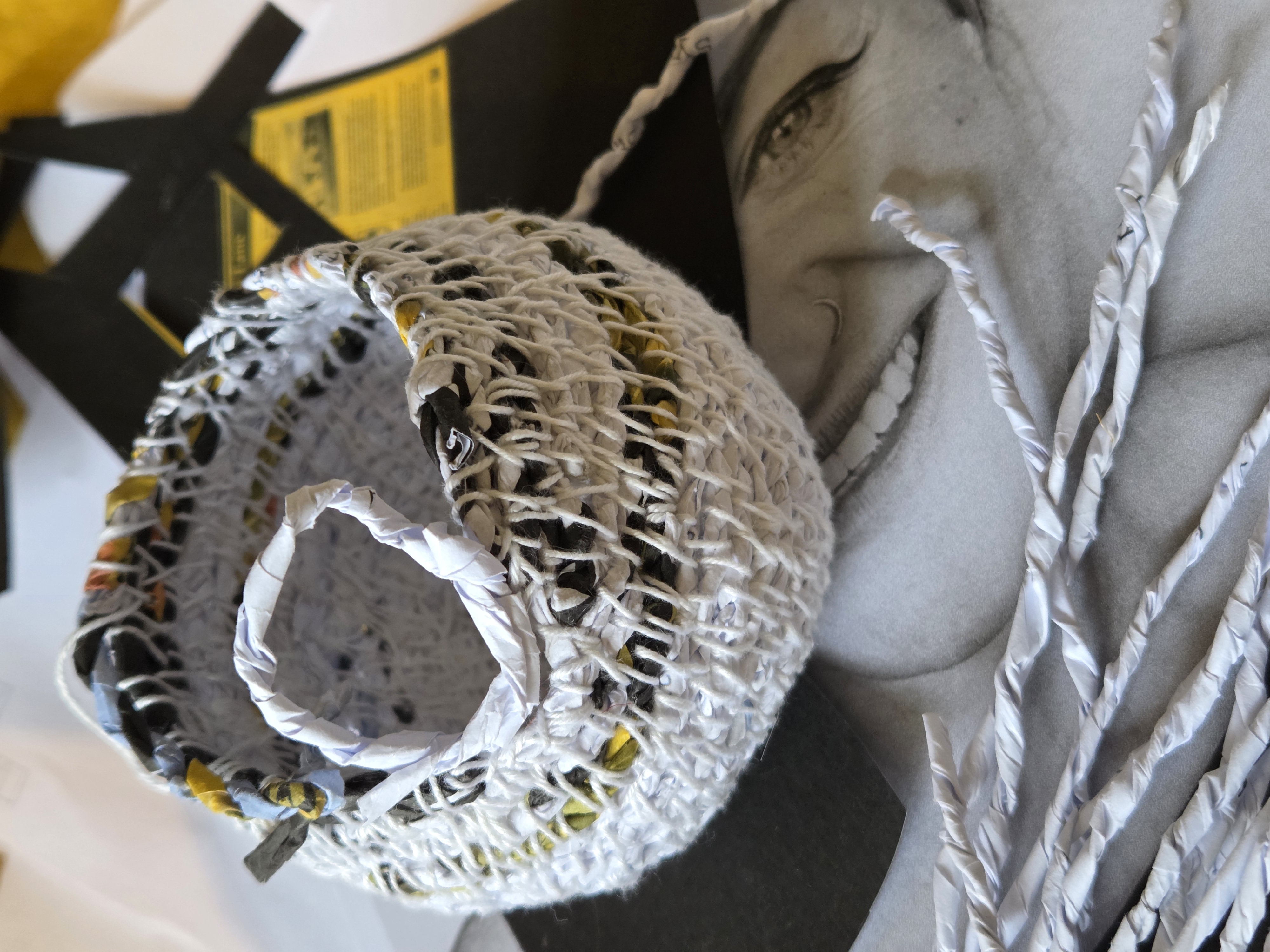
The discarded photocopies from Derbyshire Supergirl collected in a carrier bag under my desk. At first they were simply the remains of something I had decided not to continue. Gradually I began to see that they held the marks of the thinking, uncertainty, mistakes and changes that had taken me there. Ursula K. Le Guin’s Carrier Bag Theory helped me move away from the heroic figure and towards the idea of a carrier: something that gathers, holds and protects fragments without forcing them into a single conclusion. I cut and twisted those discarded sheets into paper cordage and learned how to build a small vessel by hand. The material was irregular and the method had to be worked out through repeated testing. That process echoed what I had been witnessing in the Creative Agents, who were also responding to what their communities gave them rather than following a fixed template.
What The Vessel Held
The final response became a small handmade paper vessel made from the rejected Derbyshire Supergirl material. It did not claim to solve community evaluation or turn the Agents’ experiences into a single answer. Instead it held the attempts, conversations, uncertainty and care that had accumulated through the listening process. This project changed how I understand creative evaluation. Testing, changing direction and admitting that an earlier response is incomplete are not failures around the edge of the work; they can be part of the evidence itself. Creative listening has continued to influence how I work across community projects, particularly the way I notice relationships, overlooked details and the things that do not fit neatly into a conventional project ending.
Commissioning Creative Listening
Creative Listening is the name I use for a form of creative and participatory project evaluation that pays attention to relationships, lived experience, learning, impact and change as a project develops. It is especially useful when numbers alone cannot explain what is happening between people, how confidence or trust is growing, or what may continue after a funded programme ends. A commission can include listening conversations with participants and teams, observation, visual or relational mapping, creative feedback methods, reflective sessions and tracing connections or emerging legacy over time. The methods are shaped around the people, place and programme rather than applied as a fixed evaluation template.
The form of the response can also be agreed around what will be useful to the organisation. That might include a visual map, reflective writing, a creative object or document, a facilitated reflection session, or a combination of approaches that helps make patterns and relationships visible. Creative Listening sits alongside conventional evidence rather than replacing it. Attendance figures, surveys, targets and funder reporting can sit beside qualitative material gathered through listening and making. The aim is not to make a project sound tidier than it was. It is to help an organisation understand what actually happened, what changed, what remains unresolved and what may be worth carrying forward.
I can work with arts, heritage, cultural and community organisations, charities and purpose led businesses delivering participatory or place based programmes. The work can be built in early so that listening develops alongside delivery, or used later as a reflective strand when a team needs to understand the relationships, learning and legacy a programme has created. If you are looking for a Creative Listener, creative evaluator or participatory evaluator for a project or programme, I would be glad to talk about what might be useful.
Follow The Research
The longer research behind this project can be followed through Collaborative Evaluation: Stephen Willats & Community Art, Searching For A Form, What Creative Listening Becomes and my final Creative Listener reflection.


