


Contemporary Community Textile Artist Derbyshire UK
Collaboration Kindness Carbon Sensitivity

Phoenix From The Bin
A Year Of Vulnerability
Found Materials, Stitched Words & The Shadow Side Of Making
Period
2024 To 2025
My Role
Artist
Project Type
Research & Development
Location
Derbyshire & Beyond
Project Overview
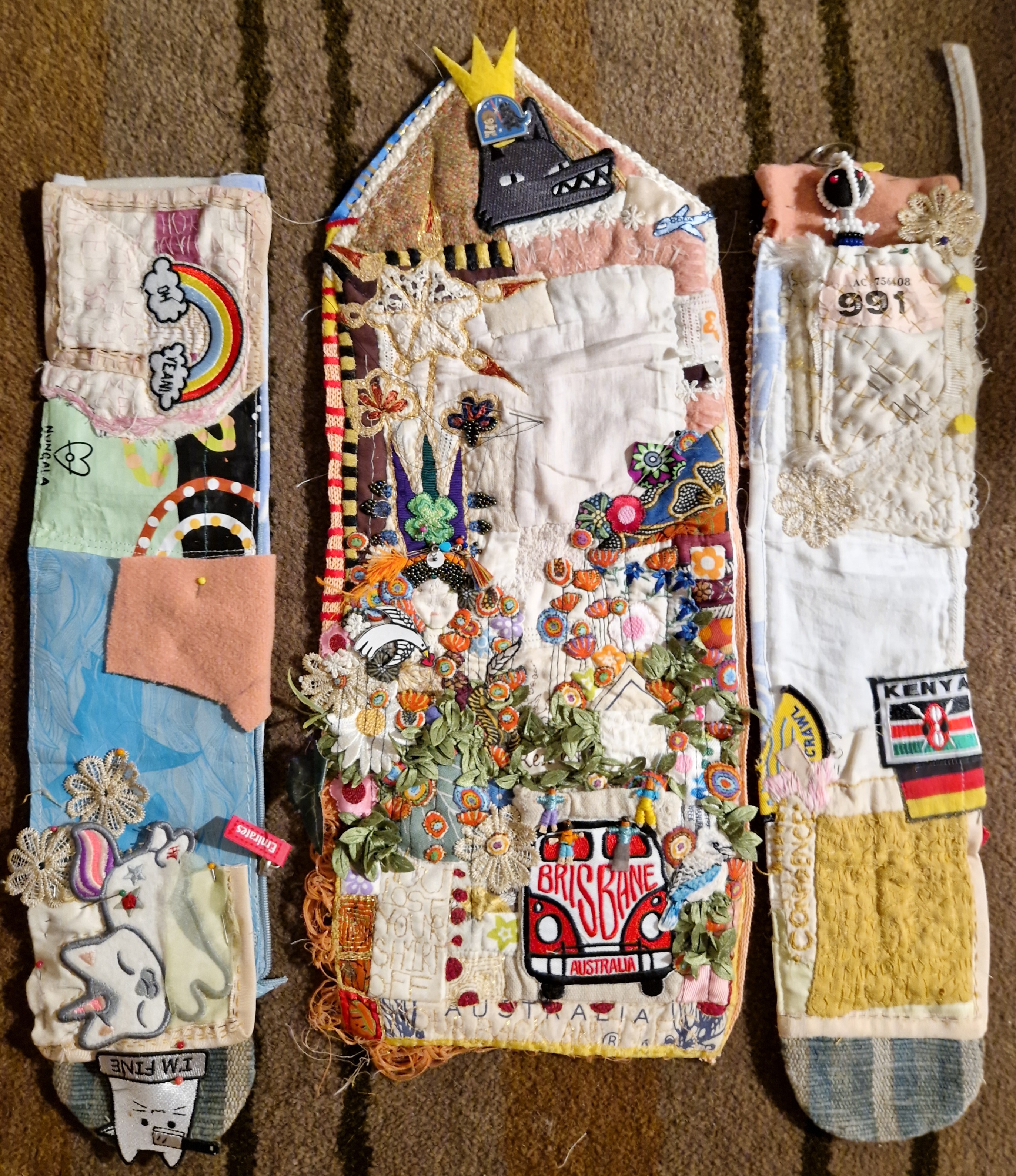
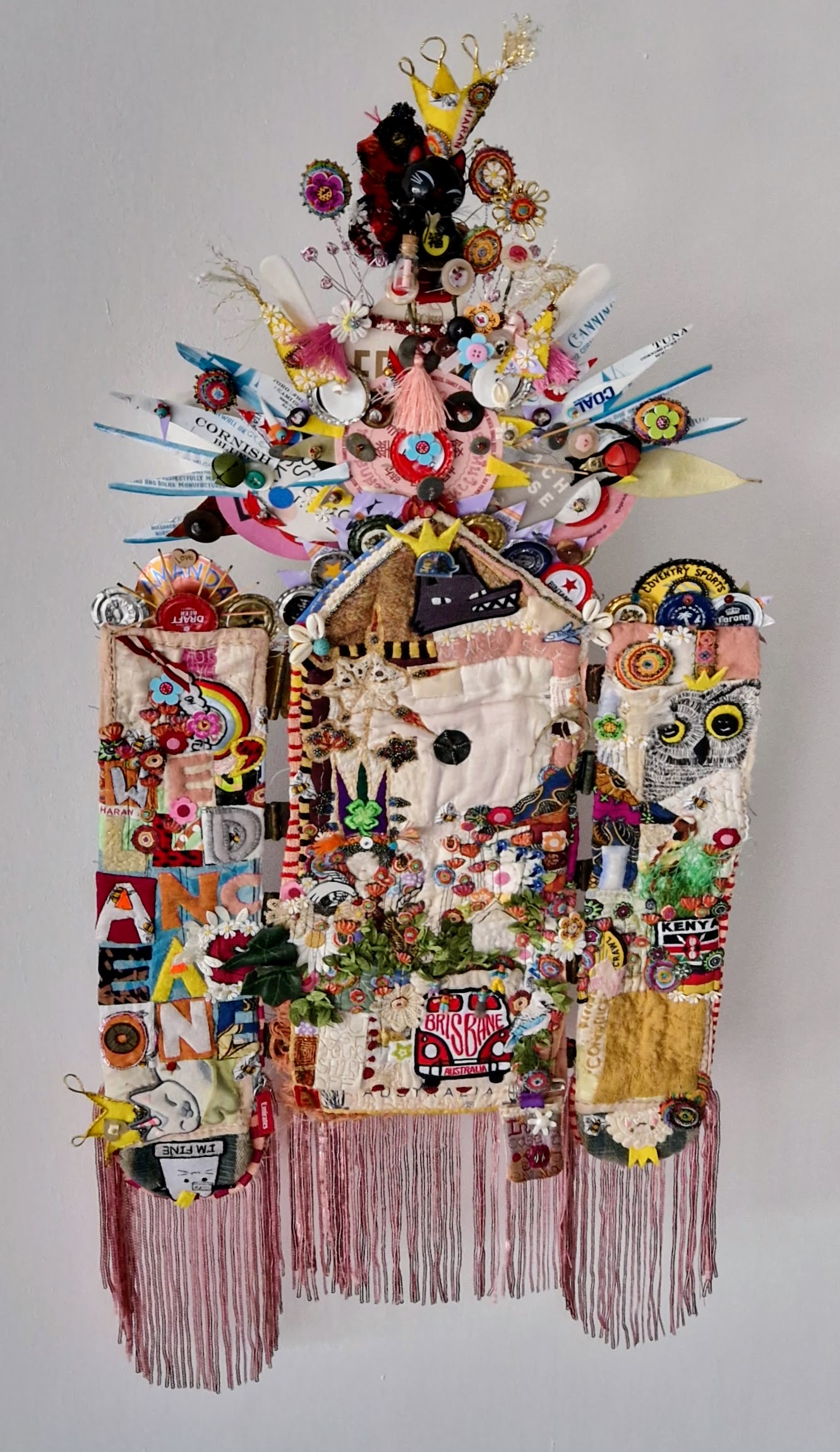
Phoenix From The Bin is a year long found material textile artwork begun in Derbyshire in 2024 and completed in 2025. I made it as a portable stitched shrine from a 1950s pink wool blanket, scraps, found objects, gifted fragments and things other people might have called rubbish. The starting point was vulnerability: if I was asking people in community projects to try unfamiliar things, risk being seen and make without knowing whether the result would be ‘good’, I felt I needed to practise some of that discomfort myself.
It travelled with me rather than living neatly in a studio. I stitched in Derbyshire, carried materials to Australia and Kenya, collected fragments as I moved and let music, fear, memory, suffrage, historic banners and Lorina Bulwer’s stitched words enter the work. The front became carefully layered and curated, while the reverse kept its knots, loose threads, mistakes and changes of mind visible.
That choice eventually shaped how I wanted the work shown. After not being selected for Coventry Open in 2023, Phoenix was chosen for Coventry Open 2025 at Herbert Art Gallery and Museum. I asked for it to hang suspended so people could walk around it and see the back as well as the front. A private experiment in being less polished had become a public artwork precisely because I had stopped hiding the messy side.
Why A Year Of Vulnerability
The idea began with a slightly uncomfortable question. In community projects I often ask people to have a go at something unfamiliar, to make in front of other people, to risk getting it wrong and to trust that the process matters even when the outcome is uncertain. I realised I was much better at encouraging that vulnerability in other people than practising it myself. Phoenix From The Bin became a way of putting myself under some of the same pressure.
The rules were deliberately simple. The work had to be portable, the tools uncomplicated and the materials found, gifted, repurposed or personally meaningful. I did not want to begin with a polished drawing of a finished object and then spend a year trying to reproduce it. I wanted to let the piece grow through what happened to me and what crossed my path. I wrote about that uncertainty while the work was still developing in my Embracing Vulnerability blog.
A Portable Shrine That Travelled
A 1950s pink wool blanket became the base, and the work slowly took on the feeling of a small portable shrine. Because it could fold and travel, it came with me rather than waiting at home for a tidy studio session. I carried a bundle of saved objects and scraps from Derbyshire to Australia, then added new things as the journey unfolded. In Wollongong I bought printed cloth with Aboriginal designs and found pieces of blue netting on the beach. Those fragments entered the textile alongside things I had already brought from the UK.
The making continued in Kenya, where I stitched while visiting a factory. That matters to the story because the journeys were not simply inspiration collected for later. The textile was physically present while I was moving through different places, so travel, waiting, conversation and whatever materials were available could become part of it immediately. The piece accumulated rather than being designed all at once, and the places it passed through became embedded in the surface.
Putting Myself Into The Work
At the centre I placed a stitched woman who represented me. She wears a crown connected to my long interest in suffrage, surrounded by flowers, fragments and small objects that had gathered meaning during the year. I was not trying to make a conventional self portrait. It was more like placing a version of myself inside the clutter of the work and allowing her to sit among the things I was carrying.
Fear entered too. The Big Bad Wolf became a way of giving some of it a shape. Rather than explaining every worry neatly, I let symbols, scraps and repeated stitching do some of the speaking. That looseness was important. The work could hold something without requiring me to turn every feeling into a clear sentence for somebody else.
When Words Were Not Enough
Stitched language has interested me for years, particularly the densely embroidered writing of Lorina Bulwer. Her work made me think about what happens when words are slowed down and physically laboured into cloth. Phoenix gave me another place to explore that question. Some sections contain words, while others became more heavily worked when language felt inadequate. The pressure, density and repetition of the stitch could carry something alongside the literal meaning.
That interest also connects to my earlier Common Threads story cloth work, where I had been thinking about textile as a way of holding experiences that may be difficult to express directly. Phoenix was not made within a therapeutic process, but the fascination with stitched words, silence, repetition and what cloth can carry continued into this work in a more personal form.
Rubbish, Treasure & Ready Steady Cook
The title came from the material attitude as much as the finished appearance. Some ingredients were precious because somebody had given them to me, others because I had picked them up in a particular place, and some would have looked like rubbish to almost anyone else. I like that change of status. A scrap becomes significant because of where it came from, who handled it or what it ends up sitting beside.
The construction followed the same logic. The side panels were joined with second hand hinges bought on eBay. They did not match, and the solution was awkward, but matching hardware would almost have contradicted the piece. I sometimes describe this as my ‘Ready, Steady, Cook’ way of making: work with what is in front of you, understand its limitations and let the solution become part of the artwork rather than disguising it. The line ‘We’ll Dance As One’, taken from music I was listening to while making, found its way into one of those panels.
Historic banners fed into the edges of the piece too. At the People’s History Museum 2024 Banner Exhibition in Manchester I photographed the Rossendale Valley Textile Workers Union banner and became particularly interested in the fringe along its lower edge. Phoenix developed its own fringe from saved sequin trim, ribbons and hanging treasures. That habit of noticing older textile structures and allowing them to reappear later runs through my practice, as does the material thinking set out in my sustainability manifesto.
The Shadow Side
The back became as important as the front. Usually the reverse of embroidery is the part we are taught to tidy, cover or keep out of sight, but that felt wrong for a year centred on vulnerability. I wanted the knots, loose threads, joins, mistakes, abandoned routes and changes of mind to remain visible. If the front showed the choices I had eventually arranged, the back showed some of the uncertainty involved in getting there.
I began to think of it as the shadow side of the work. It was not an excuse for careless making and it was not a performance of messiness. The point was that process leaves evidence. Community participants rarely get to make without somebody seeing the unsure stages, yet artists can become very skilled at editing those stages out of the final story. Phoenix asked me to leave more of mine in.
From Rejection To Coventry Open 2025
There was another layer to the vulnerability experiment. In 2023, while working on Coventry Open community outreach, I had encouraged other people to submit work to the exhibition. I applied too and was not selected. That was useful experience, but it also meant that submitting Phoenix two years later carried a little history with it. There was no guarantee that the object I had spent a year making, with all its deliberate awkwardness and personal material, would be wanted in a gallery.
Phoenix From The Bin was selected for Coventry Open 2025 at Herbert Art Gallery and Museum. The selection did not suddenly make the experiment successful, but it changed the context around it. Something that had begun privately in Derbyshire and travelled with me through Australia, Kenya and ordinary days at home was now being encountered by strangers in Coventry.
I asked for the textile to be suspended so visitors could walk around it. Showing only the carefully layered face would have hidden the part that had become most important to me. The knots and untidy reverse therefore entered the exhibition on equal terms with the front. After a year of trying not to edit away vulnerability, the public display depended on people being able to see it.
What Phoenix Changed
Phoenix From The Bin did not teach me to stop caring about finish. It changed what I thought a finished work was allowed to contain. Beauty, careful curation and skill could sit beside a mismatched hinge, a beach scrap, a loose thread or a decision that had visibly changed halfway through. The work became stronger when those things were allowed to remain part of its history.
It also made my material choices feel more connected to the rest of my practice. Reuse is not simply an environmental instruction I add at the end of a project. Found and repurposed materials arrive with limits, previous lives and relationships, and responding to those things changes the artwork. Some of the most meaningful parts of Phoenix began as objects that were cheap, discarded or easy to overlook.
The question that started the year still feels useful in my community work. If I ask other people to take creative risks, I need to understand something of what it feels like to be visible while I am unsure too. Phoenix gave me a way to practise that through stitch, travel, rubbish, memory and a deliberately exposed back. Coventry Open gave the experiment a public ending, but the more important change was learning that I did not have to polish away every uncertain part before a piece was allowed to be seen.


