


Contemporary Community Textile Artist Derbyshire UK
Collaboration Kindness Carbon Sensitivity

Work On Walls
Community Exhibition Project
Deepening Community Relationships Through Artist Collaboration
Period
2023
My Role
Community Engagement Officer | Artist & Community Liaison
Project Type
Collaborative Project
Location
Herbert Art Gallery & Museum, Coventry
Project Overview
Work On Walls was a major community exhibition project at the Herbert Art Gallery & Museum in Coventry, running from 23 June to 3 September 2023. It grew from the lockdown exhibition Work On Windows, which placed artworks on the Herbert’s external windows so people could experience art without entering the building. Work On Walls brought the idea back inside. Eight contemporary artists responded to the Herbert’s collections, and my responsibility was for two community relationships: Art Riot Collective working with Mim, also known as Jemima Graham, and Escape Arts in Stratford upon Avon working with Roo.
Both groups were already known to me through my Turner Prize 2021 community engagement work. I wanted to continue those connections rather than treat each exhibition as a separate one off encounter. For me, community engagement was about building trust between the museum and the people it serves, and that takes time. Cultural spaces can represent another institution that people feel nervous about approaching or excluded from, particularly when they have not previously felt as though those spaces belong to them.
From Work On Windows To Work On Walls
During Covid, Work On Windows had been designed so art could be encountered from outside the Herbert. Work was placed directly onto the external windows, giving people a way to see art without having to enter a public building at a time when many people did not yet feel comfortable doing that.
For me, Work On Walls almost reversed that movement. Instead of asking how art might reach people outside the museum, we were thinking about how people might feel able to come back through the doors and take part inside. The Turner Prize period had already shown me how much time it can take for trust with an institution to grow, so I did not want the work to reset to zero when one exhibition ended.
Art Riot Collective & Mim
I already knew Art Riot Collective through the wider network that had grown around Turner Prize 2021. For Work On Walls I worked with Mim, whose practice was rooted in play and experimentation. She became interested in images of Coventry Cathedral held within the Herbert’s collections, so with a colleague I helped organise and risk assess a visit to Coventry Cathedral. The group used the visit as live research, looking closely at the stained glass, drawing and gathering ideas together.
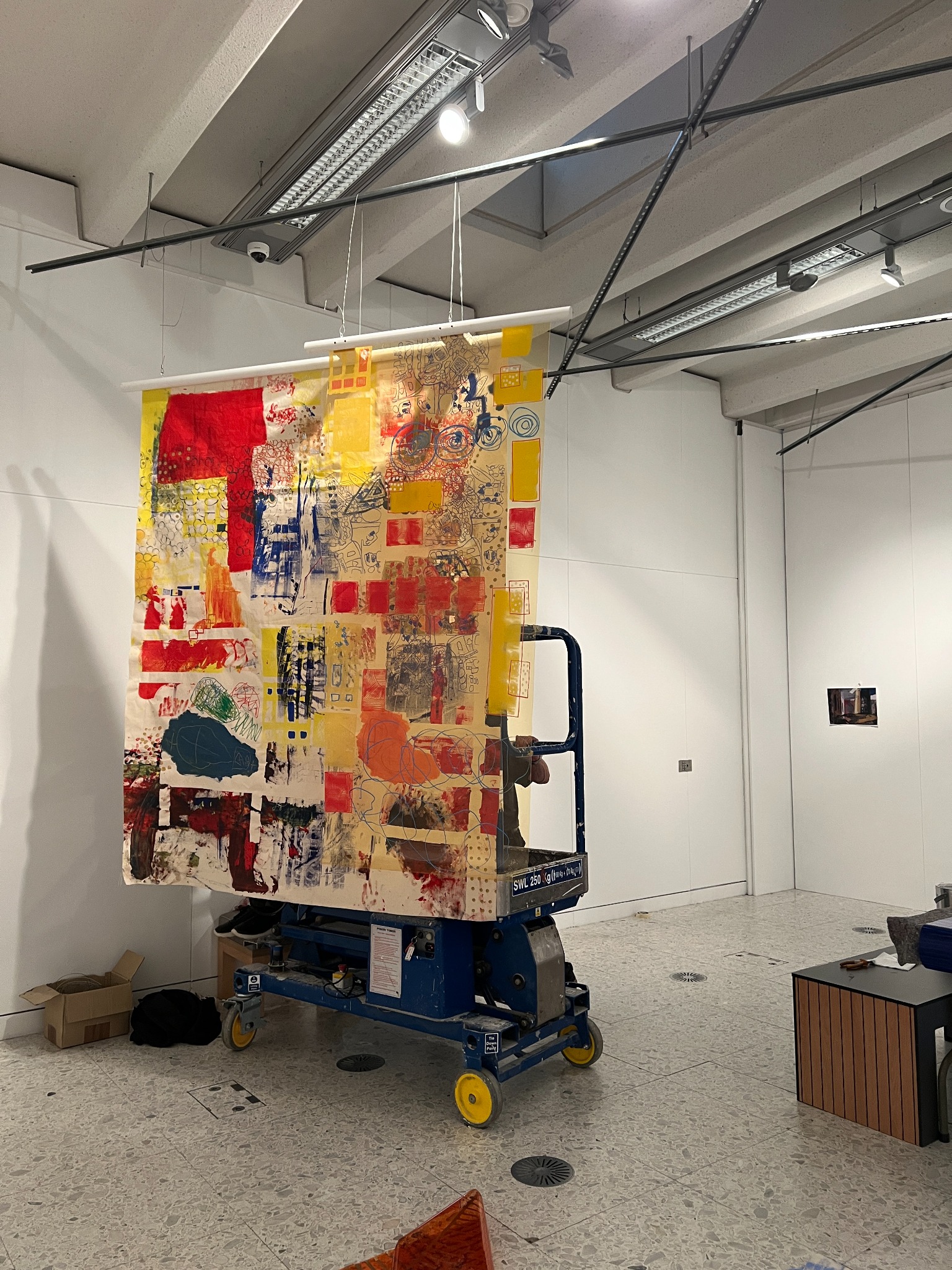
The rest of the sessions took place at Art Riot’s studios. Artists drew and screen printed motifs onto coloured and translucent materials and worked across much larger shared surfaces as the piece developed. Those parts were brought together into a large hanging installation for the Herbert. My role was not to author the work. I organised the sessions, supported Mim, helped the group and acted as another pair of hands so the creative relationship could work in practice.
Escape Arts & Roo
Escape Arts was a youth group in Stratford upon Avon that I already knew through the Turner period. One reason I wanted them involved was that being outside Coventry could leave them on the edge of some of the city’s cultural networks and funding opportunities. Stratford is often imagined as affluent, but that does not mean every young person or every community there has the same access to art and culture.
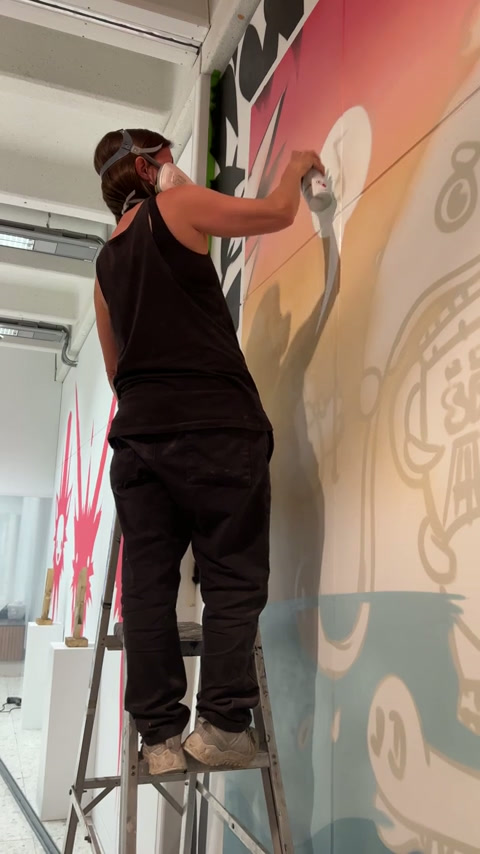
Roo was asked to respond to something in the Herbert’s collection and was drawn to the museum’s large taxidermy animal collection. I knew how fondly some Coventry people remembered being taken to see those animals when they were younger, while much of the collection was no longer on show by this point. Roo’s love of animals fitted naturally with the group. We ran several sessions in Stratford, looking at which animals might appear, drawing and developing ideas, and making the butterfly characters with Roo that became part of the final installation. The young people also tried spray painting, something they had wanted to do for a long time.
I brought one of the Herbert’s curators to Escape Arts to talk directly with the young people about how an exhibition is put together and to answer their questions. That brought another part of the museum’s working life into their own space rather than expecting them to come to the Herbert first. I supported Roo, organised the sessions and worked alongside everyone as another pair of hands. The activity also contributed to the group’s wider Arts Award learning at a time when Art was not available to them at GCSE through school.
Why Continuity Mattered
I had first connected with both groups through Turner Prize 2021 and wanted Work On Walls to deepen their connection with the Herbert. I do not believe one workshop or one exhibition visit is always enough. My hope was that, over time, people would feel more comfortable in the building, more connected to staff and collections, and increasingly able to return without needing me to be the person who brought them through the door.
That belief is personal as well as professional. Textile and art teachers did this for me: they made creative spaces feel accessible, encouraged me to take my ideas seriously and helped me feel that I belonged there. I have always wanted to pay some of that forward. At the Herbert, that meant using the opportunities available to me to help people build confidence in their own relationship with art and with the institution, rather than making that relationship dependent on me.
For me, this is part of building citizen power. A community’s relationship with a museum cannot depend on one member of staff. When I left the Herbert, I made sure contacts, connections and relevant project information were handed over so whoever took over my role had enough context to continue the work. The aim was continuity: people feeling able to enter, ask questions, participate and belong in their own right.
From Community Collaboration To Public Exhibition
My role was to act as the conduit between each artist, the community group and the Herbert. Alongside the relationship building, there was a practical layer of work that often stayed out of sight: communicating between everyone involved, coordinating dates, times and venues, planning access, carrying out or coordinating risk assessment, and making sure the conditions were in place for the artist and group to work together. The groups developed their own creative responses through the process, while decisions about the final presentation of the work in the exhibition remained with the individual artists.
The resulting collaborations formed part of Work On Walls from the beginning rather than being added after the exhibition had been developed. The Herbert’s official Work On Walls exhibition page records the eight artist exhibition and its direct to wall approach. By the launch, the gallery was full of people moving between the large scale works; the photograph in this gallery is the moment where months of organising, making and trust became visible to a wider public. Culture Coventry’s 2023/24 trustees’ report recorded 16,487 visitors to Work On Walls, giving some sense of the scale the project eventually reached.


