


Amy Twigger Holroyd’s Fashion Fictions & My Imagining Muscle

On Friday 9 October 2026, I found myself standing at the far end of a line in a room at Nottingham Trent University, showing just how willing I was to go along with a fictional government proposal to ration new clothing. There was one other participant alongside me, and quite a lot of room between us and some of the others. I hadn’t realised my position would be quite so far out until I could see it laid out across the floor. I was taking part in Amy Twigger Holroyd’s Fashion Fictions: Transitions workshop, and although I had arrived curious about her research, I was beginning to discover a few things about myself as well.
As a contemporary community textile artist based in Riddings, Derbyshire, I spend a great deal of time adapting, reusing and finding possibilities in the materials available to me. The other participant at my end explained that her country had once operated a similar system, so she was open to the idea. Her experience gave her a way into this fictional world, while mine came partly from knowing that beauty, originality and self-expression could still be found in things that already existed. I could also see a rather personal advantage. My head is so full of possibilities that having fewer clothes to choose from might actually be a relief in the morning.
From Derbyshire Flax To Fashion Fictions
My connection with Amy’s work had begun before this workshop. The Museum of Making had invited me to bring her thinking together with Derbyshire’s flax heritage, and I read her book in preparation for my talk. In Derbyshire Flax Heritage At The Museum Of Making, I describe how I used Fashion Fictions and World 259 to open a conversation about local fibres, shared skills and regional production. I contacted Amy, and that connection eventually brought me into this workshop with master’s students at Nottingham Trent University. At the museum, I had invited people to handle historic textiles and extract flax fibre themselves. I was curious about how Amy made her research accessible through participation.
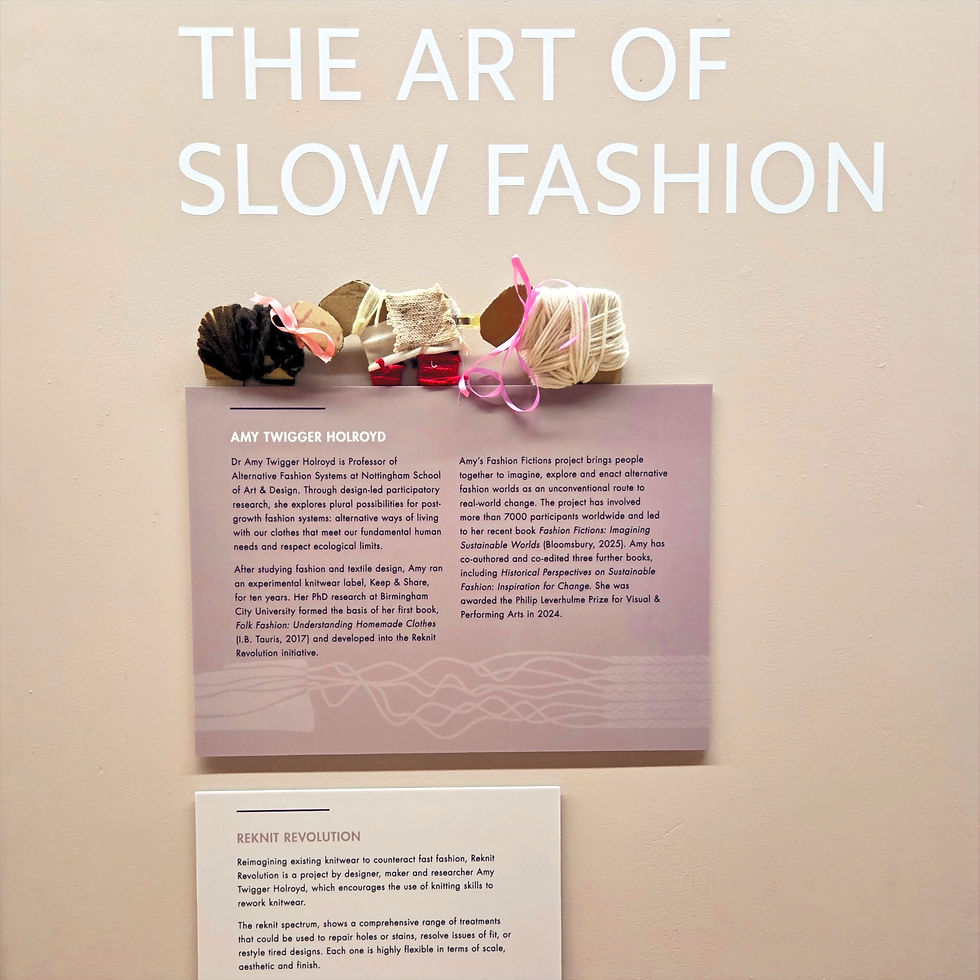
Amy is Professor of Alternative Fashion Systems at Nottingham Trent University. Her Fashion Fictions project, founded in 2020, invites people to imagine different ways of living with clothes through fictional parallel worlds. Her book, Fashion Fictions: Imagining Sustainable Worlds, was published in 2025. Amy describes Fashion Fictions: Transitions as an 'experimental spin-off', exploring how sustainable fashion policies might work in everyday life and how “creative practices and grassroots democracy” could help bring about change. In the scenario we encountered, a new clothing-rationing policy was about to affect people’s lives. We had room to consider what that might mean, including the bits we weren’t comfortable with.
I found the workshop so accessible. Reading had given me a way into Amy’s thinking; moving around the room, doing exercises and exploring the ideas with other people helped me understand them through experience. Even before we got into the main activity, we were being encouraged to think differently. It was whole-body learning and participation, and I could feel how much I enjoyed being given that space. I believe Amy’s work matters beyond the questions it raises about fashion sustainability. It gives us an opportunity to flex our imagining muscle. There seem to be so few opportunities simply to imagine in everyday life, yet how do we begin moving towards better versions of our world if we struggle to picture them?
Clothing Rationing & Finding My Place On The Line
The first line-up made our different responses visible. Some participants didn’t trust the government, some feared restrictions on self-expression, and others worried about their future jobs as designers in such a market. People in the middle wanted more information before deciding. They felt they didn’t yet know enough about the proposed system to take a position. These were relevant concerns, and I respected them. There was room for someone to be interested, worried or undecided without needing to arrive at the same answer as everyone else.
Hearing those views didn’t change my opinion very much. As a certified carbon literate artist, I am already committed to sustainability. I have attended UN summits on methane mitigation and, through Walking Forest, helped build a participatory environmental artwork that went to COP in Glasgow. I am still part of Walking Forest, and at the time of this workshop was looking forward to a Zoom reunion. The fictional proposal also fitted with my manifesto: adapting to the materials and means available, reducing waste and consumption, and remaining willing to learn as the work develops.

I think I am growing in self-confidence and becoming less afraid to stand in a different place. I hate conflict, and I was perfectly happy to respect alternative views as valid while keeping my own. There was no need for an argument. I sometimes think I must have been a suffragette in a former life, not one at the front, but the sensitive banner maker at the back. Making something that expresses a conviction is familiar territory for me; seeing that conviction expressed by where I placed my own body in a room was a different experience.
A Glorious Smorgasbord Of Fictional Archives
We were then invited to explore more information, and Amy had created the most glorious smorgasbord of ‘archive’ materials. There were EastEnders scripts, magazine front covers, guides, protest memorabilia and government information booklets, all giving glimpses into different parts of this imagined nation. They were exquisite and so believable that they could have come straight from the 1990s. As far as I understood, Amy and I were the only people in the room who had been alive then, so we also brought our own memories of the period to the experience of looking at them.
I particularly liked the magazine covers. One was a fictional version of Drapers Record and another was a home knitting magazine, bringing the clothing industry and home makers into the story through recognisable publications. They were beautiful to look at, but their detail also helped me consider the different voices, perceptions, beliefs and claims within this world. We discussed whether we could believe the information in the archive, which I found interesting. There was a healthy scepticism about the government voice. Looking convincing didn’t mean that everything presented to us would be accepted without question, and the materials gave us something specific to examine and discuss.
From there, we were given characters from the imagined time: a teenager, a textile worker, a high-street clothing retailer, a designer and others. I became a vintage clothing boutique owner. Giving us someone else’s position to consider was such a clever part of the workshop. Imagining what someone might feel or think, or how a situation might unfold, comes quite readily to me. I began to recognise that my imagining muscle might be one of the strongest parts of my being, and now I had a shop to think about.
A Vintage Boutique & Ready Steady Cook Creating
When we shared our feelings with the whole group in character, I was in favour of the proposal. Second-hand clothing wasn’t rationed in our scenario, so I thought it would boost trade. People might come to my boutique to develop their self-expression or fill a gap in their wardrobe that their ration allowance couldn’t cover. Then someone asked what would happen when that stock dried up. I said I would source clothes from abroad, helping prevent them from going to landfill. I recognised that the distance travelled would be a drawback, but felt that the purpose of the sourcing would still be in the spirit of the fictional law.
Finding a way forward when a problem appears is something I have practised elsewhere. I used to help steer a supported living project in its early days, before that approach was taken up by government, and we had to solve a lot of problems on the hoof to keep going. My creative work asks something similar of me: what can I do with what is already here, and how can I adapt it before buying something else? I think of it as ‘Ready, Steady, Cook creating’, like the television programme where a bag of ingredients became the starting point for a meal. I never work with a pattern. I work with the possibilities in front of me and make decisions as I go.
My Wilderness Quilt, made with reused and recycled cloth, is one example of that way of working. Materials that might be dismissed as rubbish can still carry feeling, beauty and meaning. That experience helped me imagine how customers might still express themselves under the fictional proposal. The boutique-owner role gave me another setting in which to use that resourcefulness, while the questions from the group made me consider what might happen beyond my first enthusiastic response.

Back On The Line & Into My Wardrobe
At the end, we returned to the lines to show how comfortable we felt now that we knew more. I stood where I had stood at the beginning. During the discussion, we noticed that we saw ourselves as willing to change, while believing that society would find change difficult. We were curious about that difference. There was no tension around it, just an interesting shared observation about how we imagined our own readiness and that of the wider world. I didn’t leave with a tidy explanation, but it felt like a useful question to have opened together.
I did leave with a commitment to an experiment. If I rationed my own wardrobe, how would it actually feel to live with limited choice? I haven’t taken all my clothes out and put only a few back, but I have begun doing it in practice, choosing a small selection and keeping those pieces in rotation. I quite like it, really. Once I have worked out a limited clothing plan that suits my life, I think I will sort the wardrobe itself to match. For now, I am giving myself time to find out what works. The imagining has found its way into my mornings, and I’m curious to see how it feels as I carry on.


