


Contemporary Community Textile Artist Derbyshire UK
Collaboration Kindness Carbon Sensitivity

Turner Prize 2021
At The Herbert
Connecting Coventry Communities With Turner Prize 2021 Through Participation
Period
2021
My Role
Community Engagement Officer
Project Type
Institutional Engagement Programme
Location
Coventry
Project Overview
Turner Prize 2021 came to the Herbert Art Gallery and Museum during Coventry UK City of Culture. I arrived as Community Engagement Officer only two weeks before the exhibition opened, on my first project at the Herbert. My role became the bridge between the museum’s audience objectives, the five shortlisted collectives and Coventry communities who were not always finding their way into major contemporary art spaces.
I began by reading the Herbert’s business plan to understand who the museum needed to reach, including lower engagement postcode areas and men. Then I went into the Turner Prize galleries and met Array Collective, Black Obsidian Sound System, Cooking Sections, Gentle/Radical and Project Art Works to understand what mattered to each of them and what kinds of local relationships they hoped to build. From there I started making calls, sending emails and going out to meet groups in their own spaces. What began as a baptism of fire became the project that taught me that community engagement is not simply getting people through a gallery door. It is about preparing people and institutions for each other, making the unwritten rules visible, listening, returning and building something that can continue after the headline event has gone.
Starting With The Business Plan, Then The People
Turner Prize 2021 was a major part of Coventry UK City of Culture, and audience reach was being measured as part of that wider programme. I started with the Herbert’s business plan because I needed to understand where participation was already strong and who the museum was not reaching well enough. There were postcode areas to think about and particular audiences, including men. The numbers were useful because they pointed towards absence. They told me where I needed to start asking questions.
I then went down into the Turner Prize galleries while the five collectives were preparing their spaces and spoke with them about their own drivers, ideas and hopes for local contact. Their approaches were completely different. Black Obsidian Sound System were interested in sound, collective space and connecting with communities whose voices were often less visible. Cooking Sections were working through food, ecology and CLIMAVORE. Gentle/Radical brought a deep interest in locality, care and gathering. Project Art Works centred neurodivergent artists, art and care. Array Collective created an immersive social space shaped by activism, humour and gathering. My job was not to make one engagement model fit all five. It was to understand both sides and begin connecting the right people.
A Baptism Of Fire
The first days were chaotic. A City of Culture ticketing problem meant I became part of the team bringing community groups into the exhibition on opening day. I had one evening to walk through the whole show and get enough of a grasp on an artistically complex exhibition to accompany groups through it the next day. I was new to the Herbert, new to the team and new to the exhibition. The groups were having their own baptism of fire too.
It was not my finest hour, and that mattered. I did not feel I had given the best account of the mission I wanted the engagement work to have, so I went back. Instead of treating a first visit as a completed task, I started building the relationships more carefully. I met groups in the places where they already gathered, listened to what made the gallery feel unfamiliar and returned with further invitations. That early discomfort became one of the most useful lessons of the whole project: access begins long before somebody reaches the museum door.
Making The Unwritten Rules Visible
Some people did not know what behaviour was expected in a gallery, let alone inside the Turner Prize. They were unsure whether they could go into an installation, whether they could sit down, talk, laugh or simply take up space. I began to understand that part of my role was to make those unwritten cultural rules visible without telling people there was a correct way to experience the art.
Coventry Men’s Shed became one of the relationships that made this clear. I first went to meet the group in their own space. When they later came to the Herbert, Array Collective’s síbín, their ‘pub without permission’, became one of those moments where the barrier dissolved. People often hovered at its entrance because they did not know whether they were allowed inside. I loved being able to invite them in, sit down and enjoy it. On one visit a group ended up dancing to the Irish music. That moment has remained important to me because people were no longer behaving like nervous gallery visitors. They were behaving like themselves.
For some people the barrier came even earlier. If somebody wanted to attend an event but did not feel confident walking in alone, I would arrange to meet them and go in with them. Sometimes participation depended on something as ordinary as knowing there would be a familiar face at the threshold.
Working Across Five Collectives
The official Turner Prize programme makes clear how different the five practices were, and the community programme reflected that. Black Obsidian Sound System’s Coventry work included a Hillz FM broadcast and the building of a Baby B.O.S.S. sound system with local activist and community groups. Cooking Sections brought CLIMAVORE ideas into the Herbert café. I supported a day long community engagement programme with Gentle/Radical, whose approach to locality, food, conversation and gathering resonated strongly with me. Array’s installation became a place for tours, conversation and later a major legacy project. The work was not a string of identical workshops. Each collective required a different kind of local connection.
That meant a lot of phone calls, emails, introductions and visits. I was often translating in both directions: helping a collective understand Coventry communities and helping community members understand why an artist or idea might be relevant to them. Some collectives arrived with a very clear plan. Others needed more help finding the people and places that could make the local programme meaningful.
Project Art Works | Art, Care And Neurodivergent Practice
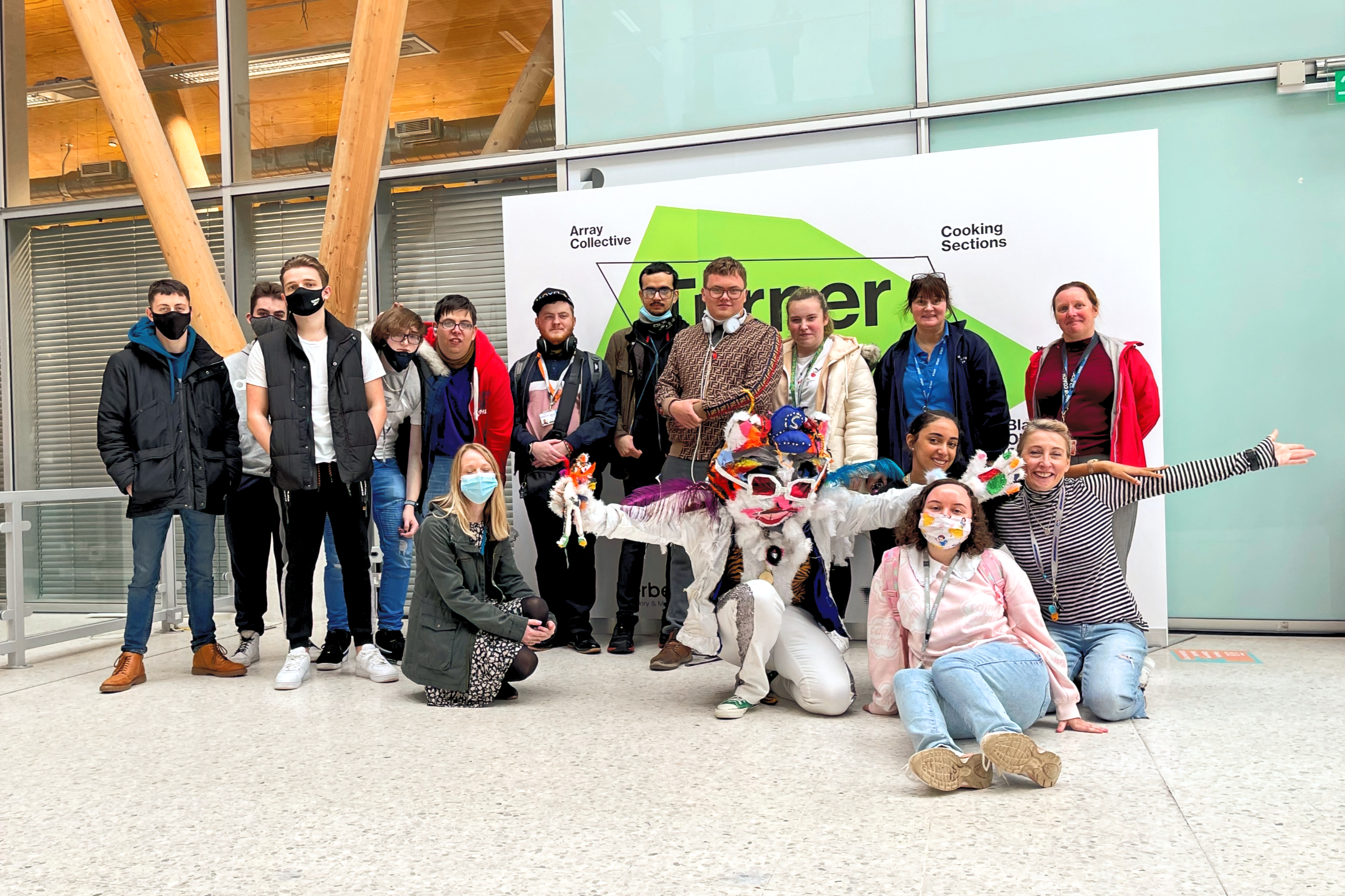
I worked particularly closely with Project Art Works. Their Turner Prize space was not only an exhibition. It included a working studio and, across the exhibition period, artist residencies, community collaboration and public conversations about art and care. That gave us a very different way of thinking about who could be an artist inside a major exhibition and what support might make that possible.
I took neurodivergent groups around the exhibition, helped arrange opportunities for neurodivergent artists to meet those groups and talk about their practices, invited neurodivergent families into the space to discuss the issues they experienced, and supported local artists to make work inside the installation. The adaptations mattered. People worked on floors, walls and tables. Some needed more physical support, some needed a smaller or calmer working area, and some simply needed to be allowed to make in their own way rather than conform to a standard workshop format.
One local neurodivergent artist travelled with me to Hastings to see Project Art Works in their own studio context and spend a day working there. The relationship did not simply stop when the Turner Prize closed. In 2022 the Herbert, Project Art Works and Outside In worked together again on Explorers residencies for neurodivergent artists, one of the clearest examples of a connection continuing beyond the exhibition.
Accessible Information, Sensory Support And Anna Farley
The accessibility work developed alongside those relationships. I took part in a quieter neurodivergent evening where lighting, sound and the use of space were considered differently. I helped launch sensory backpacks that visitors could choose to use, giving people another way to navigate the exhibition rather than assuming one visitor experience would suit everybody.
I also worked alongside autistic artist Anna Farley as she developed the accessible Turner Prize guide. I took the guide to community groups I was working with, gathered feedback and helped test whether the information actually worked for people who were less familiar with galleries and contemporary art. The Herbert’s own Turner Prize information recorded that Anna’s guide and sensory backpacks were available to support visits.
This became an important piece of practice development for me. Accessible information was not something to add at the end. It could be tested with the people who needed to use it and changed in response. I later carried that learning directly into Coventry Open 2023, where I developed accessible guidance and practical application support using the same principle: information can either create a route into participation or quietly block it.
Preparing The Institution As Well As The Visitor
As the relationships grew, I became more conscious that community engagement could not only be about preparing people to enter the Herbert. The Herbert also needed to be prepared to receive them. When I had a group coming in, I would join the front of house team’s morning meeting to explain who was visiting, what they might need and what I was trying to achieve through the visit. I wanted the welcome at the door to support the relationship that had already begun outside the building.
This sounds like a small operational detail, but it changed how I thought about access. A visitor can receive all the encouragement in the world outside an institution and still be made to feel that they do not belong once they arrive. I was beginning to understand that participation had to be designed on both sides of the threshold.
Evaluation, Accountability And What Could Happen Next
The Turner Prize sat inside a much larger partnership. I had responsibilities to the Herbert and to the Coventry City of Culture programme, and attendance and participation figures were monitored and collated for reporting, including feedback to Arts Council England. Those figures mattered, but they did not tell me enough about what I was seeing: people returning, groups beginning to trust the museum, connections forming between artists and communities, and opportunities growing out of other opportunities.
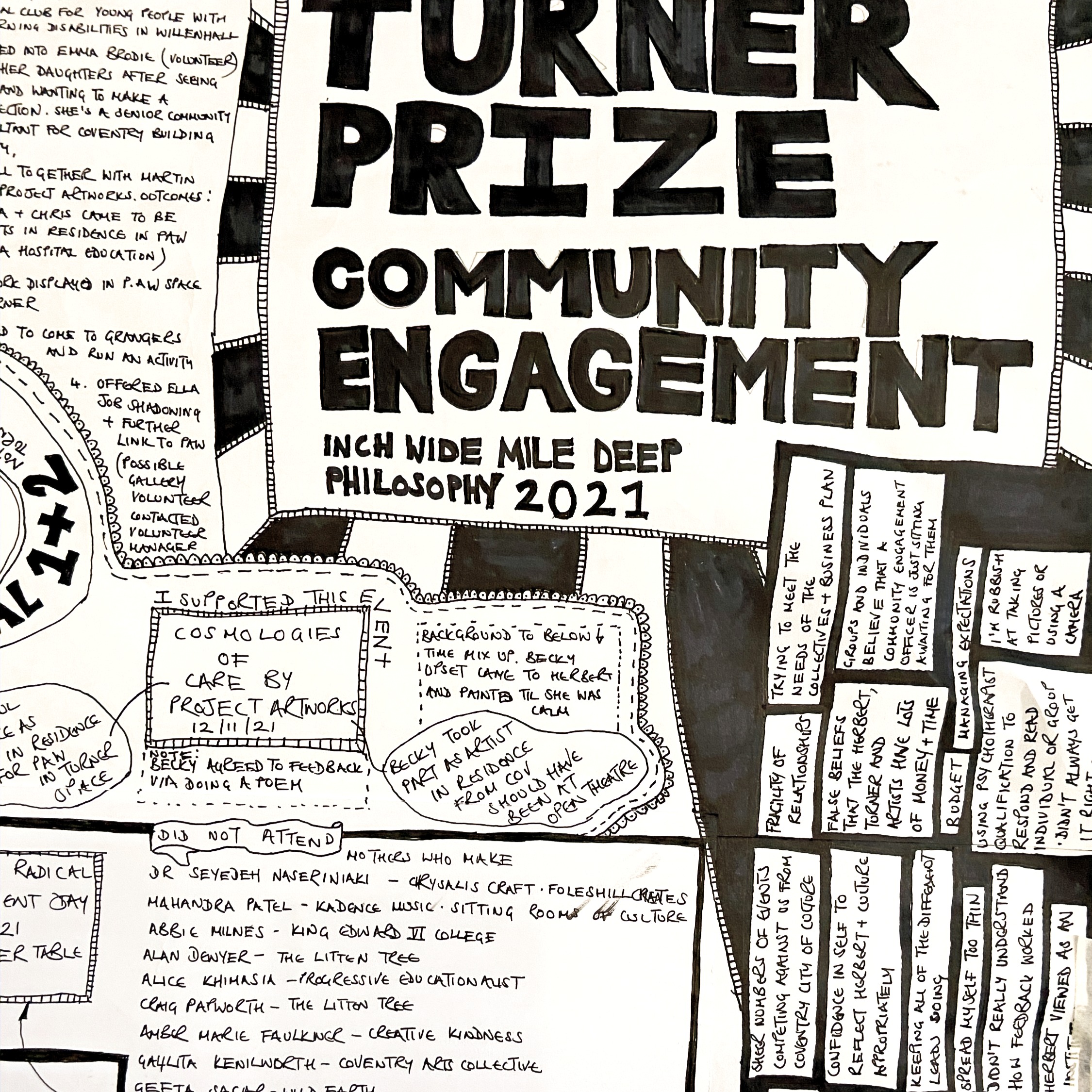
When I was asked to respond in writing to the engagement work, I struggled to make a conventional report show what had actually happened. Instead I drew a large map of the community activity. It listed events and relationships, showed how people and projects connected and, crucially, included possible legacy opportunities. I remember the drawing being presented to the Turner Prize judges and Arts Council England and receiving a positive response as a different way of communicating the work.
That drawing became an early form of the visual and relational evaluation I have continued to explore. I was interested in the statistics, but also in what numbers could not easily hold: confidence, atmosphere, repeated contact, a person dancing in an artwork, or a participant returning with somebody else. I have written more about that development in my later reflection on community project evaluation.
Legacy | What Travelled Beyond Turner Prize 2021
I wanted legacy to be considered before the project ended, not invented afterwards. Some of the relationships and ideas developed during Turner Prize 2021 continued into later Herbert work. The most visible textile legacy became The Coventry Banner, inspired by Array Collective and developed as a citywide project in its own right. The Project Art Works relationship continued through later neurodivergent artist opportunities. Groups I had first met through Turner Prize reappeared in later projects, so each new piece of work did not have to begin from zero.
Turner Prize 2021 was where several strands of my later practice first came together properly: going to people rather than waiting for them to come to me, returning instead of relying on one invitation, helping people decode institutional rules, testing accessible information with the people who would use it, preparing front of house as well as participants, connecting artists and communities rather than treating them as separate worlds, and thinking about legacy while a project was still alive. I arrived two weeks before the opening without a finished methodology. I left with the beginnings of one.


