


Contemporary Community Textile Artist Derbyshire UK
Collaboration Kindness Carbon Sensitivity

Coventry Open 2023
Community Outreach Programme
Taking An Open Exhibition Beyond The Gallery
Period
2023
My Role
Community Engagement Officer
Project Type
Community Arts Outreach
Location
Coventry and the West Midlands
Project Overview
As Community Engagement Officer at the Herbert Art Gallery and Museum, I worked collaboratively with curator Alice Swatton to extend the reach and uptake of Coventry Open 2023. I took the opportunity out into community groups, pubs, clubs, grassroots creative venues and sixth form settings across Coventry and the West Midlands, helping to challenge the misconception that the Open was only for professional artists. I also promoted the first Young People's Coventry Open, introduced in 2023 for artists aged 15 to 18. Alongside clearer guidance, an online submission portal, drop in sessions and practical technology support helped make the application process easier to understand and access. More than 1,000 works were submitted, with 248 shortlisted and 108 selected for exhibition. I also applied independently and was shortlisted, returning two years later as a selected artist in Coventry Open 2025.
Taking Coventry Open Out Into The Community
When I joined the Herbert Art Gallery and Museum as a Community Engagement Officer in 2021, much of my role involved finding ways to reach people who might not normally think that a gallery, exhibition or open call was meant for them. By the time we began working towards Coventry Open 2023, I had already learnt a great deal through Turner Prize 2021 and the community projects that followed. Sitting inside a gallery and hoping unfamiliar communities would find an opportunity was never going to reach everybody, so the work increasingly took me out into Coventry and the wider Midlands, meeting people in the places where they already gathered and talking with them about what was happening at the Herbert.
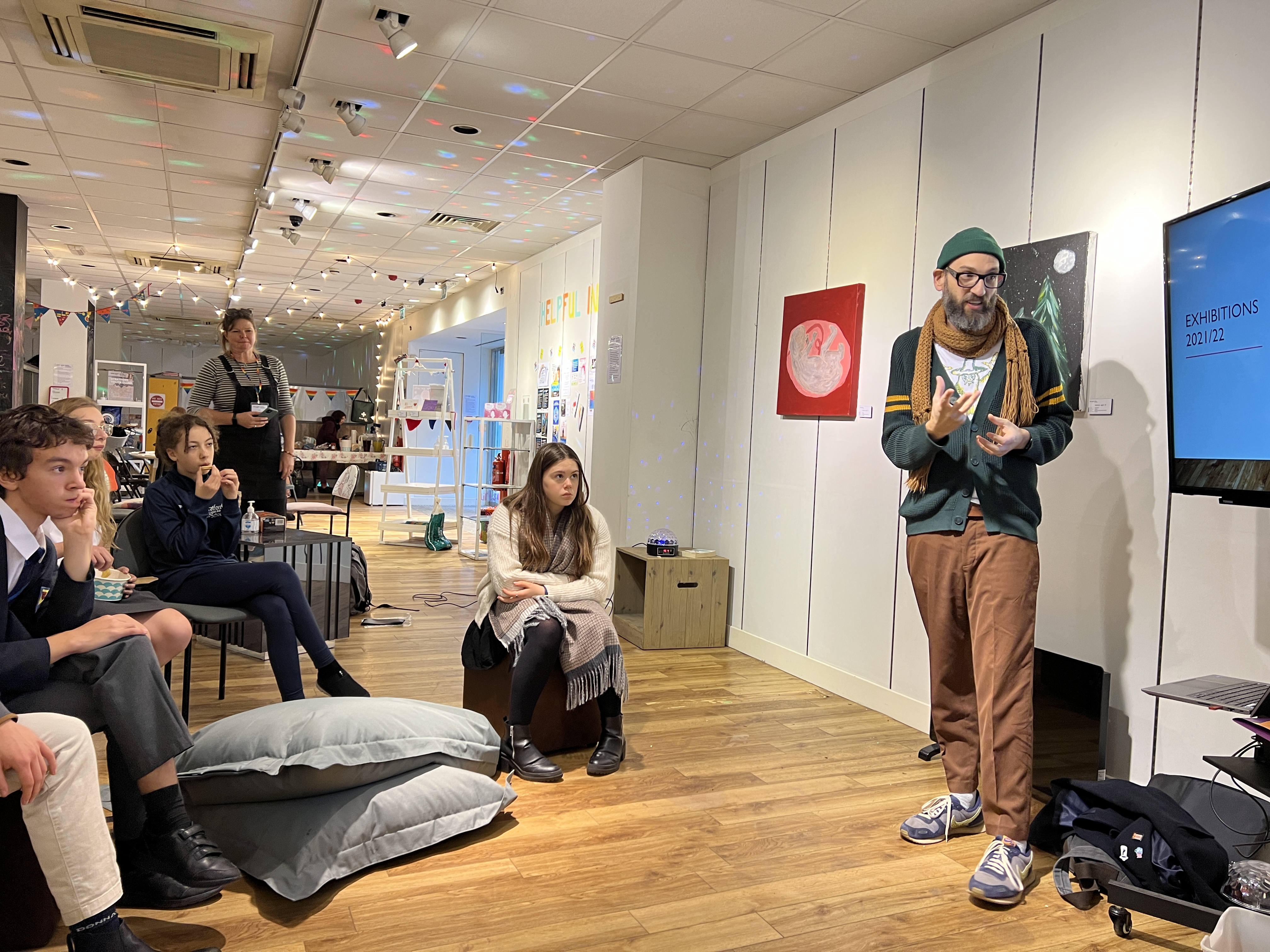
Coventry Open was returning for the first time since 2020, and in many ways we were finding our way through it together. I was working collaboratively with Alice Swatton, who was a new curator at the Herbert and experiencing her first Coventry Open too. My particular task was community outreach, extending the reach and uptake of Coventry Open 2023 and making sure information travelled beyond the gallery. I visited community groups, pubs, clubs and other venues across Coventry and the wider Midlands, talking to people about what the Open actually was, how the application process worked and whether it might be something they wanted to take part in.
The outreach was not random. We had identified postcode areas through the Herbert’s business planning where engagement was lower, and I used that information alongside relationships I had already begun building during Turner Prize 2021. I went back to groups I already knew as well as developing new relationships. I have always been more interested in going an inch wide and a mile deep than trying to meet everybody once. Some people were ready to take part straight away, while others needed a second or third invitation before the Herbert began to feel like somewhere they might belong.
A separate strand of the outreach was promoting the first Young People's Coventry Open, introduced in 2023 for artists aged 15 to 18. That meant taking the opportunity into youth groups and sixth form settings, including King Edward VI College in Nuneaton, and explaining the process without assuming that young people already understood open calls or gallery systems. The young people's route had its own guidance and deadline, so it needed targeted outreach rather than relying on the adult Open's general publicity.
This was not a simple publicity exercise or a case of putting out an open call and waiting to see who responded. It involved a great deal of time, travel, conversation and follow up. I was moving between community groups, venues, meetings and the Herbert, explaining the opportunity in different ways depending on who I was speaking to, listening to what was putting people off and then trying to find practical ways around those barriers. Some people needed reassurance that their work was worth submitting, others needed help understanding the language of the application, and some needed practical support with technology or photographing their work. There were many small conversations behind the larger numbers, and much of the work was about returning, following things up and making sure people did not feel they had been invited into something and then left to work it out alone.
One thing that became clear through those conversations was that there seemed to be a misconception around Coventry Open itself. Some people assumed it was a complicated process, or that an open exhibition at a major gallery must really be for professional artists. For others, the language around applying could make the whole thing feel more difficult before they had even begun. In reality, Coventry Open 2023 was free to enter and invited visual artists living, working or studying across the West Midlands, working in a wide range of media. There was quite a gap between how open the opportunity actually was and how some people perceived it. Part of my work was to help close that gap and make sure that not already knowing how gallery systems worked was not the thing that stopped someone from submitting their work.
We developed an online portal to support the application process, alongside clearer information about what people needed to provide, and I developed an easy to use guide that broke the process down into ordinary language. Digital access was only part of the answer, though. Not everybody wanted to sit alone in front of an online form wondering whether they were doing it correctly, so we also created online and face to face question and answer sessions, drop ins and practical technology support where people could ask questions and get help with their applications.
The accessible guide I developed for Coventry Open grew from work I had previously done alongside artist Anna Farley during Turner Prize 2021, where I learnt more about neurodivergent inclusive approaches to information and access. I carried that thinking into Coventry Open, using clearer language and practical guidance to make the application process easier to understand and helping develop the online portal around the needs I was hearing about through community engagement.
The wider support programme included practical help for people who needed assistance with the digital side of submitting work. At an access supported session with Art Riot Collective at FarGo Village, disabled and neurodivergent artists could get help with things such as photographing their work and completing the online submission form. Tablets and a camera were available so that people were not automatically excluded because they did not have the right equipment or felt uncertain about using the technology. Those sessions mattered because they gave people somewhere to ask the questions they might otherwise have kept to themselves and removed some of the practical hurdles that can make an opportunity feel out of reach.
My collaboration with Alice was an important part of this work. Whenever her schedule allowed, I encouraged her to come out with me and present Coventry Open directly to community groups rather than keeping all of those conversations inside the Herbert. That took organisation and coordination, but it changed the feel of the engagement. Instead of a group only hearing about the opportunity through me, they could meet the curator responsible for the Open, ask her questions directly and see a management face of the Herbert sitting in their own community space.
People felt important and seen because the gallery had made the effort to come to them. That mattered particularly for groups who did not automatically feel that major cultural institutions were places where they belonged. For me, this became an important part of community engagement. It was not simply about standing between an institution and a community and passing information backwards and forwards. Sometimes the most useful thing I could do was create the opportunity for people from either side to meet directly, ask questions and begin to understand one another differently.
Working so closely with Coventry Open also gave me a better understanding of what happened after an application disappeared through the submission portal. The final decisions were made by an independent judging panel and I had no involvement in choosing which artworks progressed, but being close to the process allowed me to see the care, discussion and difficult choices involved in looking at such a large number of very different submissions. From outside, selection for an exhibition can feel mysterious, particularly if you are new to applying. Seeing more of that process made it feel human rather than impenetrable, and that helped when I was talking to people who were nervous about putting their work forward.
Making Coventry Open more accessible did not mean telling people that everybody who entered would be selected. It meant helping people understand what they were applying for, making the route into the opportunity clearer and giving them enough information to decide whether they wanted to try. Rejection is part of applying for exhibitions, but not being selected does not mean that the opportunity was never meant for you in the first place. That became something I understood personally as well as professionally.
For me, the work did not finish when somebody pressed submit. I tried to stay alongside the whole journey. That could mean helping someone photograph their work or complete a form, being there when artists brought work into the Herbert so there was a familiar face waiting for them, supporting the practical running of the judging process without being involved in the selection decisions, and attending the exhibition launch so people who were new to the Herbert had somebody they already knew to say hello to and celebrate with.
By the time submissions closed, Coventry Open 2023 had received more than 1,000 works. My earlier project records compare this with a usual figure of around 500. From those submissions, 248 works were shortlisted and 108 were eventually selected for the exhibition. I would never claim that community outreach alone created the increase in submissions because many people across the Herbert were involved in delivering the Open, but the scale of the response showed why reaching beyond the usual gallery networks mattered. Behind those numbers were hundreds of individual decisions to have a go, and behind many of those decisions were conversations, repeat visits, practical help, questions answered and people being given enough confidence and information to take the next step.
Applying To Coventry Open As An Artist
Alongside my community engagement work, I was also trying to find more confidence in myself as an artist. During Coventry Open 2023 I made my own independent application. It was completely separate from my employment at the Herbert, I had no involvement in the judging of my work, and I went through the same application process as everybody else. I was shortlisted, but my work was not selected for the final exhibition.
That experience put me on the other side of many of the conversations I had been having with people in the community. I knew how the process worked and had spent months encouraging other people to put themselves forward, but pressing the submit button myself still brought uncertainty with it. Being one of the 248 shortlisted applications but not one of the final 108 works selected for the exhibition also brought home something I had been trying to communicate through the outreach work. Reaching the end of one application without getting into the exhibition did not mean I should stop calling myself an artist or decide that Coventry Open was not for people like me. Sometimes putting work forward, allowing it to be seen and trying again is part of developing a practice.
Two years later, after leaving my role at the Herbert and continuing to develop my independent textile practice, I applied to Coventry Open again. This time I was selected. My hand stitched textile work ‘Phoenix From The Bin’, made through a year of gathering found, discarded and gifted materials, was exhibited in Coventry Open 2025 at the Herbert Art Gallery and Museum.
Returning to the Herbert as an independent exhibiting artist felt very different from standing there as a member of staff encouraging other people to take part. In 2023 I had helped take Coventry Open out into communities, had made my own application and reached the shortlist. In 2025 I came back through the same doors with my own work on the wall. There is something quietly satisfying about that sequence because it reminds me that the advice I had been giving other people applied to me too.
Relationships Beyond One Exhibition
Coventry Open 2023 was part of a much wider period of community engagement at the Herbert. The relationships developed through Turner Prize 2021 did not disappear when that exhibition finished, and some people and groups returned through later projects including the Coventry Banner, Daniel Lismore, Divided Selves and Work On Walls. Over time that changed the way I understood community engagement because it became less about persuading somebody to attend one event and more about building enough familiarity and trust for people to decide whether they wanted to come back for something else.
That kind of relationship building takes time. It is often made up of things that are difficult to count: returning to the same group, remembering an earlier conversation, answering another question, introducing somebody to the right person or simply being present often enough that a cultural organisation begins to feel less remote. Coventry Open brought many of those strands together because the work was not only about telling people an opportunity existed. It was about staying alongside them for long enough that some felt able to act on it.
I was always aware that when I walked into a community space I was also carrying the Herbert with me. For some people, a large cultural institution could feel distant or bring assumptions about whether it was really for them. I could explain that the door was open, but somebody within their own community saying that they had been welcomed, supported and had a good experience could be far more powerful.
I began to think of those relationships rather like mycelium, spreading quietly through existing networks. A successful experience did not have to end with one participant. It might become a recommendation, another conversation or somebody bringing a friend the next time. That way of thinking connects with a later reflection in my blog about how movements grow through early followers and trusted community voices.
Sometimes participation meant walking through the museum doors. Sometimes it meant making something with other people, submitting an artwork or attending an exhibition. Sometimes it was simply a conversation in a community hall, pub or group meeting that made another cultural opportunity feel slightly less distant. That way of working still sits underneath my community textile practice now: going to where people already are, explaining things without assuming prior knowledge and, where possible, helping the people making decisions inside cultural organisations meet communities directly rather than always expecting communities to make the first move.


