


Flax, Encounter & Responsive Relational Practice At Derbyshire Makes Bolsover

Updated: Sep 16

Derbyshire Makes Bolsover began for me at 8 a.m. in Wetherspoons alongside a small group of artists and makers quietly talking through the familiar anxieties that often come before public events. We spoke about rain, passing crowds, outdoor setups and what the day itself might become once the streets began to fill. There was something reassuring in that shared uncertainty before we all stepped out into the centre of Bolsover carrying the different creative offerings that mattered to us, mine arriving as armfuls of flax, fibres, stems and small matchbox seed holders.
Preparing To Step Into Public Space
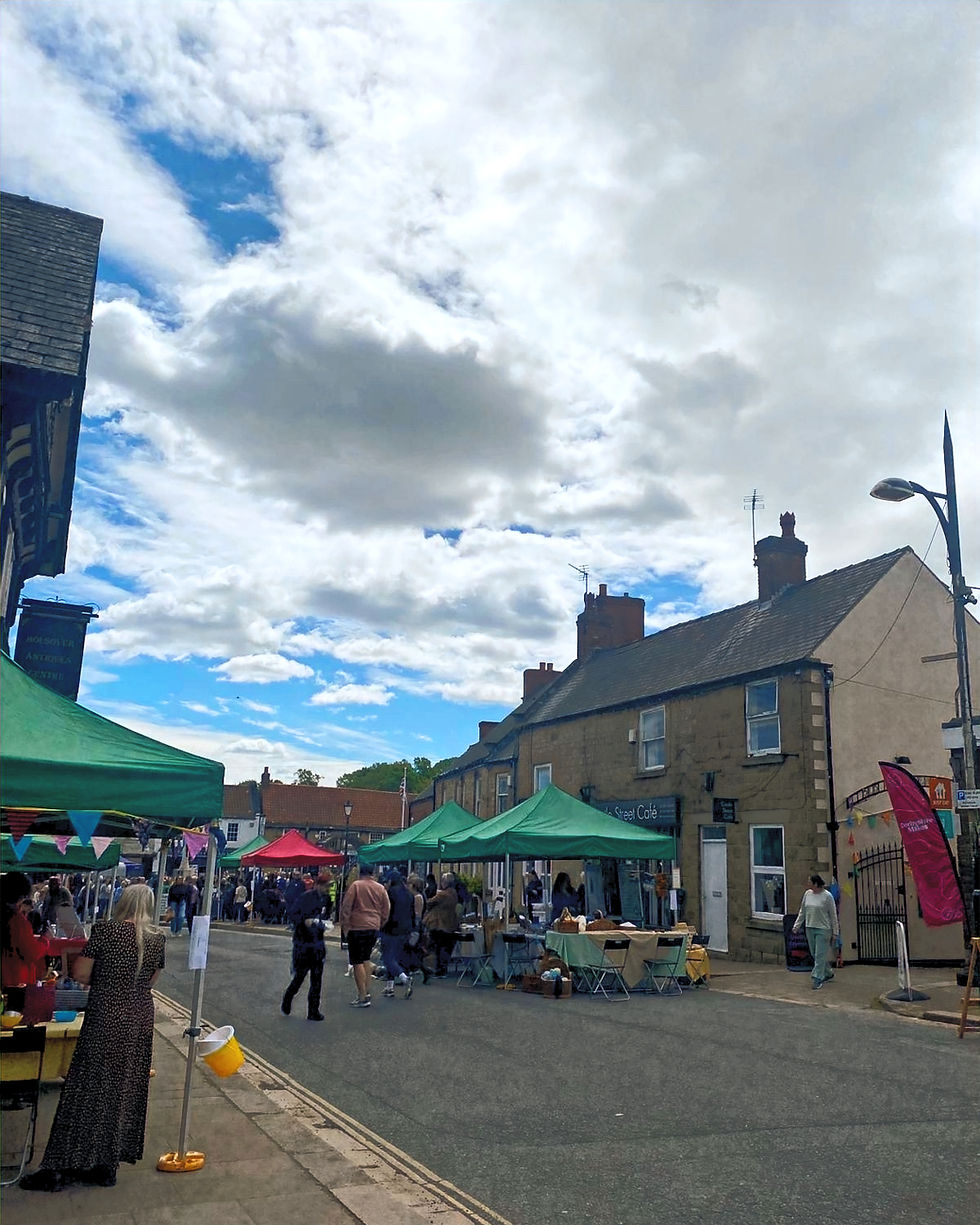
Organised by Junction Arts and Platform Thirty1 as part of Derbyshire Makes, the streets had been temporarily closed to traffic, allowing artists, performers, families and visitors to gradually ooze through the town centre. I shared a stall with fellow Alfreton artist and weaver Claire Hunter, creating a space where weaving, flax, fibre and conversation unfolded side by side within the movement of the street itself.
The wind constantly moved up the slight incline leading towards Bolsover Castle, lifting loose fibres, catching stems, and occasionally pulling the handwritten cardboard signs back down, almost as quickly as we had managed to put them up. I had made the signage myself from pieces of reused online delivery packaging, while much of the temporary stall setup had either been repurposed from what I already owned or sourced second-hand through eBay. Somehow, the roughness and impermanence of it all felt completely suited to the day itself. Compared to the earlier Heanor event, where audiences arrived intentionally into an indoor venue already expecting film, fibre and textile discussion, Bolsover demanded something far more immediate and responsive.
It quickly became clear that the seated basket making activities I had originally prepared did not really suit the rhythm of passing trade moving through the streets. People were curious, but often stopped only briefly before continuing on. Rather than resisting this, I gradually adapted the flax activities in response to how people naturally encountered them. Longer seated forms of making quietly fell away, and the simplest tactile interactions became the strongest moments of the day. Again and again, the encounter began with something very simple: a stem of retted flax passed from my hand into somebody else's. For a brief moment, the flax itself became a bridge between strangers, creating a shared point of touch, curiosity and attention before words had even fully formed. Handing someone a retted flax stem and showing them how to crack and wiggle it gently between their fingers immediately opened conversations in ways that felt completely suited to the movement of the street.
Flax As Connector
Throughout the day, very few people realised that linen actually comes from flax at all. Time after time, people stopped in genuine surprise as the pale fibres slowly revealed themselves from within what looked like an ordinary dry stem. At one point, a child cracked open a retted flax stem between their fingers and quietly revealed the fibres hidden inside. Almost immediately, other children gathered around, standing silently together in a circle in the middle of the closed street, waiting for their turn to watch the fibres appear for themselves. Several later left carrying bunches of flax home with them after stopping simply to see what might happen when the stems split open. Those small moments of shared attention felt far more significant than any carefully planned activity I could have imposed onto the day beforehand.

Flax repeatedly acted as both connector and conversation starter in exactly the ways I had quietly hoped it might. The bottle of retted flax also became an unexpected talking point, with a few brave souls cautiously leaning in to smell it before laughing that it was nowhere near as bad as they had imagined. The small matchbox seed holders drew people in constantly, often beginning conversations before the flax itself had even been discussed. Some visitors spoke about seeing blue flax fields years ago on land connected to houses once given away by the Chatsworth Estate, while another described a painter in Wirksworth who grew flax specifically to create linen canvas for his own work. One of the seed boxes travelled as far as the Netherlands after a conversation with a woman working within a museum there, where flax remains far more culturally visible and widely recognised. Standing together in the street in Bolsover, we found ourselves talking about how some places had managed to retain those connections to flax and linen while much of Derbyshire's own flax heritage has gradually faded from everyday public awareness.
Seeds, Dispersal & Shared Encounter

Collecting postcodes from the seed boxes gradually introduced another unexpected layer to the project. More than fifty boxes of flaxseed travelled outward from the streets of Bolsover that day, reaching homes across Derbyshire, Nottinghamshire, Yorkshire and even to Wales and the Netherlands. People without gardens spoke about growing flax in pots or containers once they realised how little space it actually required. The growing postcode list gradually began to feel less like documentation and more like a loose mycelial network quietly spreading outward through human encounter. Some of those connections may never continue beyond the moment the seed boxes were handed over in the street, while others may gradually keep travelling through gardens, windowsills, allotments and further acts of sharing still unseen. Increasingly, I find myself less interested in controlling how people engage with the flax and more interested in simply offering an opening and allowing things to unfold in their own way.

The wider ideas behind this evolving approach to participation and encounter connect closely to earlier reflections I explored through my role as Creative Listener within the Make/Shift Neighbourhood Creative Agents programme and my writing on Stephen Willats' socially engaged practice: Collaborative Evaluation: Stephen Willats & Community Art
There are also strong connections to my earlier reflections on listening, participation and material exchange explored here: What Creative Listening Becomes: Photocopy Paper, Bags, Flax & Participatory Practice
Responsive Relational Practice
I found myself thinking again about my earlier role as Creative Listener for the Make/Shift Neighbourhood Creative Agents programme and some of the ideas explored through my reflections on Stephen Willats, particularly the way simple interactions can generate wider forms of exchange once released into public space. At the same time, I also became aware that this kind of responsive relational practice is not passive. Standing quietly behind the flax tables, waiting for engagement, would never really have worked with the street's movement. Again and again, I found myself stepping forward into conversations, offering stems into people's hands and initiating encounters that might otherwise never have happened at all. Where systems and structures sometimes risk reducing people into patterns of behaviour, I find myself far more interested in responsive relational practice rooted in presence, uncertainty, listening and embodied encounter. In many ways, I suspect this instinct comes partly from my earlier Rogerian counselling training, where meaning emerges not through control but through creating conditions in which genuine human exchange can occur.
At a time when broader conversations increasingly focus on what divides communities and how to rebuild connection, I find myself growing more interested in small-scale material encounters that create temporary moments of curiosity, attention, and exchange between strangers in public space.
My wider flax practice and ongoing Riddings Community Flax Project can be explored here: Riddings Community Flax Project
By the time we packed everything away at 3 p.m. I felt completely spent, yet strangely energised at the same time. After hours of standing in the street sharing flax with strangers, listening to stories, handing out seeds and watching fibres reveal themselves again and again in people's hands, the conversations continued circling in my head long after the streets leading up towards Bolsover Castle had begun to empty. As we packed everything away, small fragments of shive still remained scattered lightly across the closed road surface from hours of cracking flax between our fingers in the street. I left them there. The flax had moved gently through the town all day, leaving only a quiet, biodegradable trace of our time there before gradually disappearing back into the environment. There was something deeply familiar in the repeated gesture of holding my hand out with a stem of flax resting across my palm. It reminded me of the ways Mrs Fisher and Mrs Tankard had once done exactly the same for me through art and textiles, offering materials, encouragement and quiet permission to step closer without pressure or expectation.
Frequently Asked Questions
What Is Responsive Relational Practice?
Responsive relational practice is an approach to socially engaged art that prioritises presence, listening, embodied encounter and human exchange rather than fixed outcomes or heavily structured participation. Within my own textile practice, this often involves adapting activities and conversations in response to the ways communities naturally encounter materials, places, and each other in public space.
What Is The Connection Between Flax And Linen?
Linen cloth is made from the fibres found inside the stem of the flax plant. Once harvested, retted and broken, the pale fibres hidden within the stem can be separated and processed into linen thread and cloth. Many people visiting Derbyshire Makes Bolsover were surprised to discover that linen begins as a tiny flax seed.
Why Is Flax Important To Derbyshire?
Although often overlooked today, flax and linen production once formed part of Derbyshire's wider textile and industrial heritage. My own practice explores how growing flax in contemporary community settings can reconnect people with overlooked local histories, material knowledge and shared acts of making.
How Can Flax Be Used Within Community Art Practice?
Flax naturally encourages tactile interaction, conversation and shared learning. At Derbyshire Makes Bolsover, people encountered flax by handling retted stems, revealing fibres, taking seed boxes home, and sharing stories connected to linen, growing, and local history. The material itself often becomes a bridge between strangers, opening space for curiosity and exchange.


