


Contemporary Community Textile Artist Derbyshire UK
Collaboration Kindness Carbon Sensitivity

King Edward VI College
Artist In Residence
Working Alongside Art Students From First Stitches To Coventry Moves
Period
2019 To 2021
My Role
Artist In Residence
Project Type
Residency
Location
Nuneaton, Warwickshire
Project Overview
I became Artist In Residence at King Edward VI College in Nuneaton in 2019, before I began working at the Herbert. I had actually been asked the year before, but the timing was not right then. When I was finally able to take up the role, the brief was wonderfully open: make my own work in the art studio so students could see what a practising artist actually does, while also being around to talk through ideas, offer textile advice and share practical skills. I worked across two student cohorts, and because many had never studied textiles before, the residency moved between my own visible making and everything from threading a needle for the first time to using a sewing machine with confidence.
The relationship kept growing. We moved from studio conversations and first stitches into making two ambitious banners for Coventry Moves, then into exhibition visits, Coventry Open conversations, Turner Prize feedback and later trials for The Coventry Banner. Nuneaton mattered within that story too. It sat just outside Coventry's City of Culture boundary, and the relationships I built there became part of a much longer thread that later reached The Station Gallery, Daniel Lismore and Divided Selves.
A Residency Before The Herbert
I had first been asked to become Artist In Residence at King Edward VI College the year before I took the role, but at that point I could not make the timing work. When I did begin in 2019, I was not arriving with a single workshop to deliver and then disappear again. The point was to be present. I could make my own work in the art department, let students see the ordinary reality of artistic practice and be available when they wanted to ask about materials, decisions, mistakes or what happened next. I was also part of the college's wellbeing strategy working party, so the residency sat within a wider relationship with the college rather than only inside a timetable of art sessions.
That mattered because Foundation Art students were already learning to question, test and critique. They could see me thinking through my own work rather than only seeing something finished, and I could respond to what they were actually interested in. Most had not studied textiles in any depth, although questions around fast fashion, clothing and material culture gave us plenty to talk about. The studio became a place where textile knowledge could sit alongside drawing, painting, photography and the other media they were already using, without textiles being treated as a separate craft subject.
From First Stitches To Textile Confidence
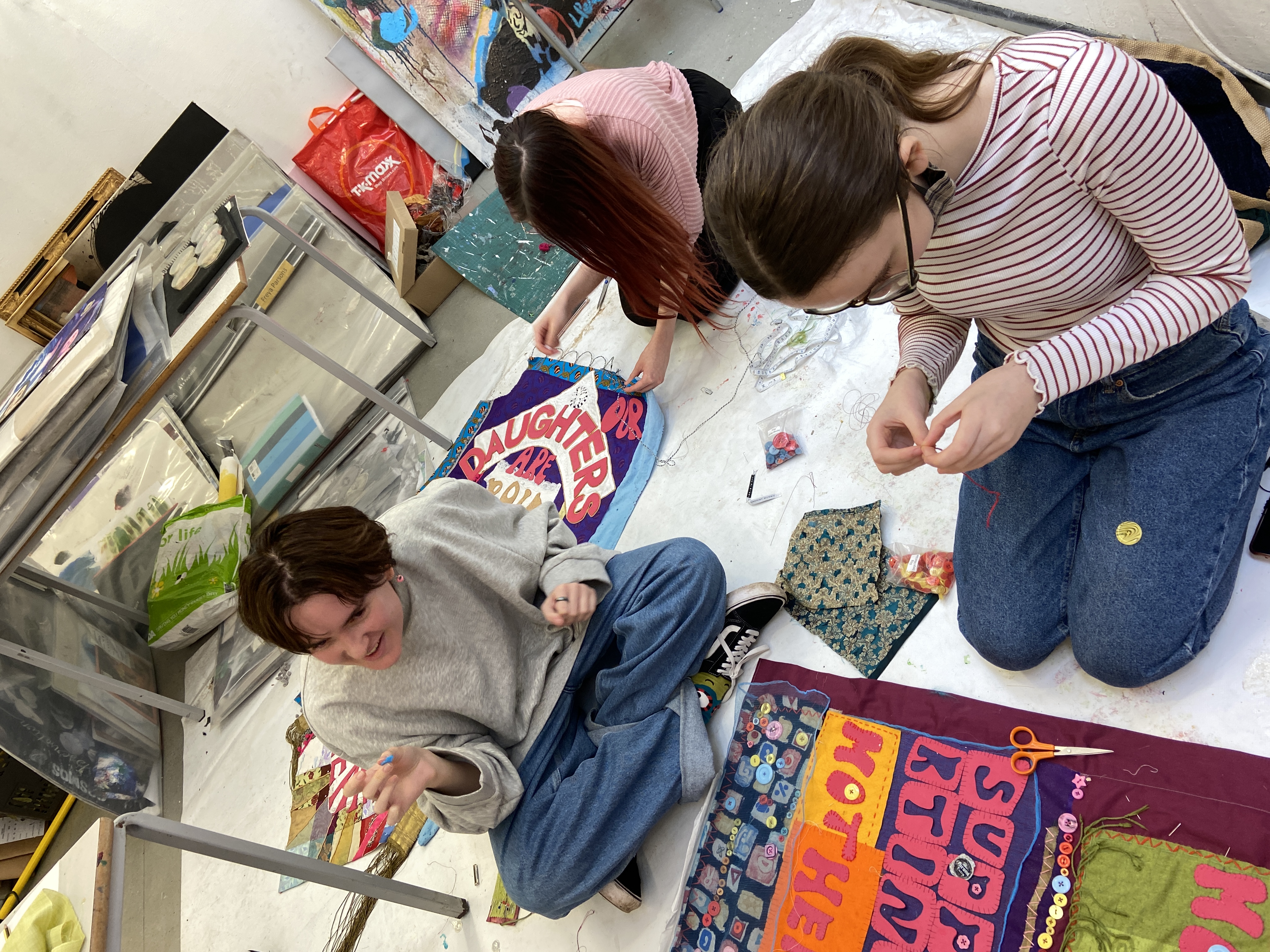
Some students had never threaded a needle, so there was no point pretending everybody arrived with the same confidence. I taught hand sewing through artists and pieces I already cared about, brought my own sewing machine into college and showed students how to use it, then let the learning open out rather than insisting that everybody should produce the same thing. The practical skills were useful, but the more important shift was seeing textiles become another art medium they could choose. Stitch, cloth, appliqué, layering and surface could carry an idea just as drawing or paint could.
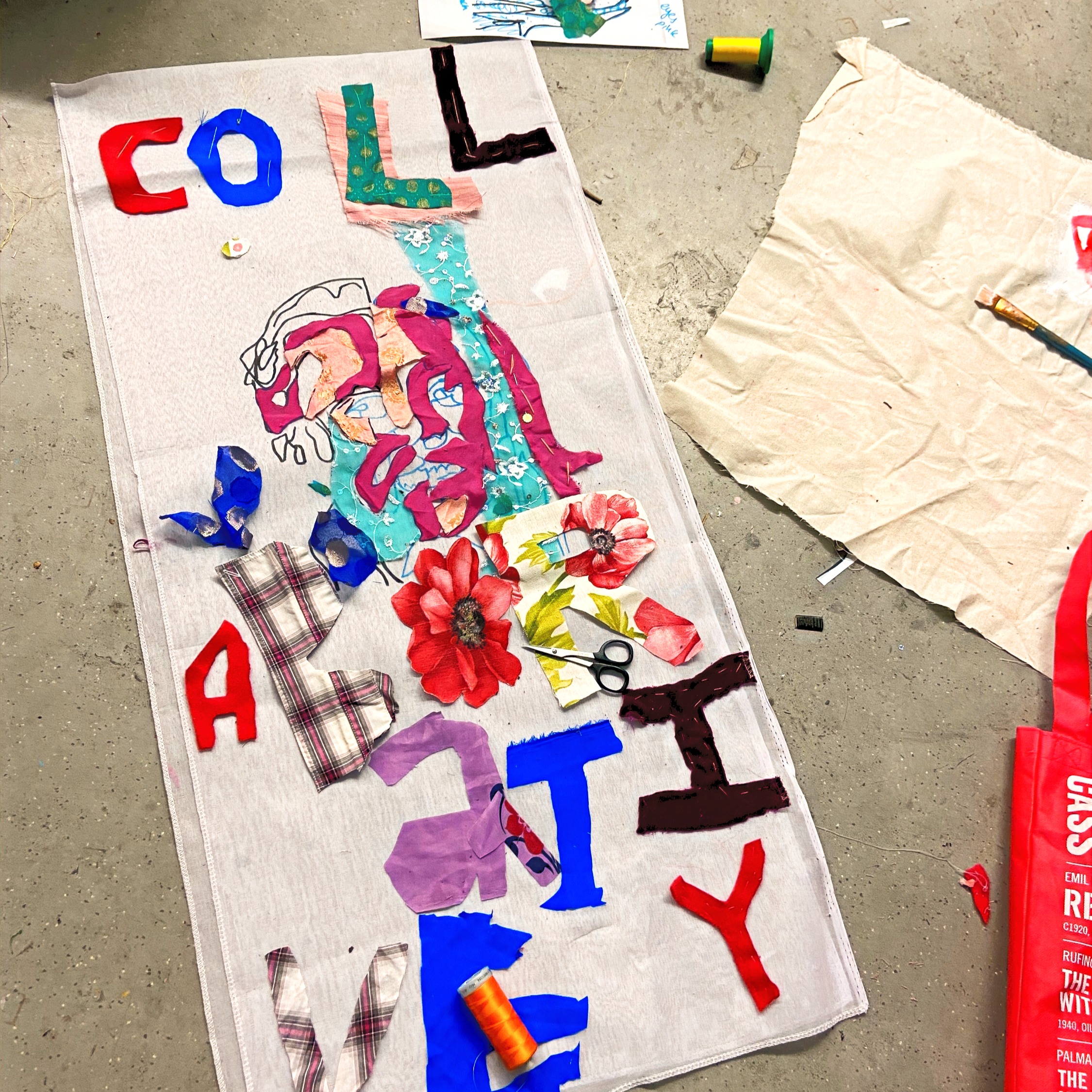
That development became very visible later when we made the Coventry Moves banners. Students who had begun with basic hand stitch were suddenly making decisions about patterned cloth, appliqué lettering, trims, buttons, fringing, layering and composition across large public pieces. The finished banners are a much better record of the learning than a list of techniques could ever be, because you can see how far the confidence had moved between the first teaching photographs and the work that eventually left the college.
Making Two Banners For Coventry Moves
In 2021 I brought Coventry UK City of Culture into the college relationship and we made two banners for Coventry Moves, the opening event for the title year. The City of Culture supplied recycled fabric for the banner bases and the words we had been asked to feature prominently had come through the Coventry Ambassadors. We sourced additional fabrics from charity shops and used found and reused materials around them, so the students were working inside a real public brief but still had room to make strong visual decisions of their own.
The wider banner programme needed methods that lots of people could take part in quickly, and many of those pieces were assembled through straightforward glued construction. At KECS we had something different: sustained studio time with art students who were already building skills. That meant we could work more slowly and materially, using hand stitch, appliqué, layered patterned cloth, trims and embellishment so the banners became textile artworks rather than simply signs carrying words. One of the finished pieces read 'Daughters Are Bold Because We Showed Them What Bold Means', and in the photographs from Coventry Moves it is easy to spot because the surface is so densely worked.
The scale of Coventry Moves also gave the students' work a very different life from an ordinary college exercise. The official evaluation records 526 people directly involved, with just under half taking part as community rather than professional performers, and 208,216 unique online viewers engaging across the weekend, watching for an estimated average of 38 minutes. The official Coventry Moves credits name King Edward VI College Nuneaton, me and eight students as Banner and Flag Makers. Many of those students were applying to university, and I wanted them to have something genuine they could put on an artist CV or discuss in a portfolio: a public brief, a formal credit and work that existed beyond the classroom.
From The College Studio Into Public Life
The banners were carried as part of the Coventry Moves opening ceremony, shown at Coventry Cathedral and Coventry Market, appeared again in the City of Culture closing ceremony and were later shown at LTB in Coventry. That public afterlife mattered to me because it completed the learning circle. The students did not simply practise a technique and put the result in a drawer. They saw work they had helped make leave the studio, become part of a major cultural programme and sit alongside the work of other communities. For young people preparing to apply to university, that was real evidence of collaboration, problem solving, textile development and professional participation.
There were lovely ordinary studio moments inside that bigger story too. One of the art teachers' dogs actually made herself comfortable on a Coventry Moves banner while we were working on it, which is exactly the kind of photograph I like because it shows the reality around the polished public outcome. There were tables covered with scraps, thread, laptops, lesson plans and half made pieces, alongside the formal credits, Cathedral displays and opening ceremony photographs. Both belong to the project.
Why Nuneaton Mattered
Nuneaton was important because it sat only a short distance from Coventry but outside the City of Culture boundary. Coventry's own annual reporting later recorded 709 events across all 18 wards of the city, while the Nuneaton and Bedworth Cultural Strategy 2023 to 2028 described a much more fragile local cultural picture, including local artists feeling left out and a significant proportion of residents travelling outside the borough to access culture. That difference between physical distance and cultural connection was something I was already noticing while the title year was happening. To the best of my knowledge at the time, I was the only artist in my immediate City of Culture network deliberately carrying this kind of sustained offer into Nuneaton.
The geography was always more complicated than the City of Culture line on a map suggested. Daniel Lismore was repeatedly understood through Coventry's cultural story, yet Daniel's own biography says he was born in Bournemouth and raised in Fillongley on the Coventry border. Nuneaton, Fillongley, North Warwickshire and Coventry were part of a much wider lived cultural landscape, even when programme structures treated them as separate places. That stayed in my thinking when I later developed engagement at the Herbert.
Returning Through The Herbert
When I later began working at the Herbert, I did not need to invent a new relationship with KECS. I went back to people who already knew me. I talked to students about Coventry Open, took them around exhibitions and used their responses within my Turner Prize 2021 community engagement. Because they were art students and already comfortable giving critique, they could be wonderfully direct. That became especially useful when I was developing The Coventry Banner. They tested the participation process and could tell me when an instruction was unclear, when a material got in the way or when I was controlling the outcome too tightly. That feedback helped me simplify the process before asking hundreds of members of the public to use it.
The Nuneaton connection kept surfacing elsewhere too. When I developed the community programme around Daniel Lismore at the Herbert, I deliberately involved The Station Gallery at Nuneaton Train Station and groups connected with it because they had also spoken about feeling disconnected from what was happening in Coventry. I returned to those relationships again through Divided Selves. By then, connecting neighbouring towns into opportunities centred on Coventry was not an accidental extra. It had become a deliberate part of how I worked.
A Relationship That Kept Growing
I often think of my practice more like mycelium than a sequence of separate projects. A relationship begins in one place, disappears underground for a while, then sends up new growth somewhere else. KECS did that repeatedly. It began with students seeing an artist at work and learning textile skills, grew into Coventry Moves, resurfaced through the Herbert, Turner Prize evaluation and The Coventry Banner, then connected into wider Nuneaton relationships through The Station Gallery, Daniel Lismore and Divided Selves.
That is probably the most important legacy of the residency for me. It taught me that participation is not only about designing a good workshop. It is about staying long enough to listen, sharing enough skill for people to make their own decisions, noticing who is not being reached, and carrying relationships forward rather than starting again every time a new project title appears.


