


Contemporary Community Textile Artist Derbyshire UK
Collaboration Kindness Carbon Sensitivity

PROCESSIONS | Women Of Shropshire: We Are Here
An Artichoke Suffrage Project With DASH & The Shropshire Subversive Stitchers
Period
2018
My Role
Support Artist | Community Banner Assembly
Project Type
Community Textile Banner & Mass Participation
Location
Shropshire and Cardiff
Project Overview
In 2018, a chance conversation at the People's History Museum in Manchester led me to PROCESSIONS, Artichoke's national artwork marking 100 years since some British women first gained the vote. In Shropshire, artist Anne Marie Lagram was leading the creation of the Women Of Shropshire: We Are Here banner through a programme of inclusive workshops organised by DASH and its community partners. I joined as a support artist, using free machine embroidery to help bring together the separate pieces made by women and girls, and stitching the DASH name and date onto the reverse of the banner. I also took part in making the smaller Boundary Way Growing Together banner, representing Wolverhampton, working alongside women in the polytunnel at the community allotment site, where folklore and storytelling became part of our time together. On 10 June, I carried that banner through Cardiff as part of PROCESSIONS. It felt extraordinary to carry something we had made together and to become part of something so much bigger than ourselves. I was so moved by Artichoke's work, and how closely its ambitions seemed to align with my own creative soul, that I went on to become an Artichoke Heart. This began an ongoing relationship with the organisation, including supporting and taking part in the community build of Sanctuary in Bedworth in 2022. Just as importantly, PROCESSIONS introduced me to people, friendships and different ways of working together that helped lay the foundations of my own approach to community making and co-curation.
More than 100 women and girls contributed to the Shropshire banner through inclusive making led by Anne Marie. The project connected textile skills, disability arts, local communities and public expression, while the banner became part of a national procession involving around 80,000 women and girls across four UK cities.
The story continued long after the march through Anne Marie's mentoring, Artichoke's donated suffrage sashes and later work including Sew What? and the Coventry Banner. Anne Marie also helped me secure an Arts Council England Developing Your Creative Practice (DYCP) grant for my Irregular Thread research. Looking back, I recognise an early example of the interconnected, mycelium approach that still shapes my practice.
A Manchester Trip That Opened Up A New Direction
Manchester has always been special to me. I studied Textile Design and Design Management at UMIST, so returning to the city felt like returning to somewhere that had helped shape me. In April 2018 I went to the People's History Museum for the launch of Helen Pankhurst's book 'Deeds Not Words'. I didn't go there looking for a new project. But I spotted people wearing PROCESSIONS badges, got talking and discovered that Artichoke was inviting women and girls across the UK to make textile banners and take to the streets in a national women's suffrage procession, marking 100 years since some British women first gained the vote.
Someone suggested that the nearest artist involved was Anne Marie Lagram in Shropshire, which wasn't exactly just around the corner! I'd never been to Shropshire before, but I found Anne Marie, and I'm very glad I did. During that same Manchester trip, I visited Emmeline Pankhurst's former home, where Emmeline's Pantry was operating from the basement. The charity supported women in desperate need, and only women and children were allowed into that space. I remember going downstairs and feeling as though I had entered somewhere offering sanctuary. I touched the walls, wanting somehow to feel the energy of the women who had passed through that building and the history held within it. Upstairs, there was a small display about the suffragettes, but to me it felt rather tokenistic compared with the importance of the place itself. Although the house was already a museum, it was nothing like the beautifully developed and interpreted museum it has since become. What mattered to me that day was the contrast between the history of women fighting for their rights and the practical support still being offered to women beneath the same roof. I remember feeling such a connection with the place that I joked perhaps I'd been a suffragette in a former life.
I also visited the Whitworth and encountered Tracey Emin's textile work for the first time. That encounter with contemporary textile art opened up more questions about stitched words, imperfect edges and cloth as a way of saying something, ideas that later surfaced in my Coventry Banner work. Looking back, I think that journey to Manchester helped lay the foundations of my becoming a community textile artist. I couldn't have known it then, of course; at the time I was following my curiosity and talking to people.
PROCESSIONS 2018 & The Women Of Shropshire Banner
PROCESSIONS was a national mass participation artwork produced by Artichoke and commissioned by 14–18 NOW, with 100 textile banners created by artists and communities across the UK. On 10 June 2018 around 80,000 women and girls came together in Belfast, Cardiff, Edinburgh and London wearing the suffrage colours of green, white and violet. It marked a century since the Representation of the People Act of 1918, which gave some women the vote but not yet equality with men. The artwork wasn't only about looking back; it invited people to ask who had a voice and how women could be visible together in public.
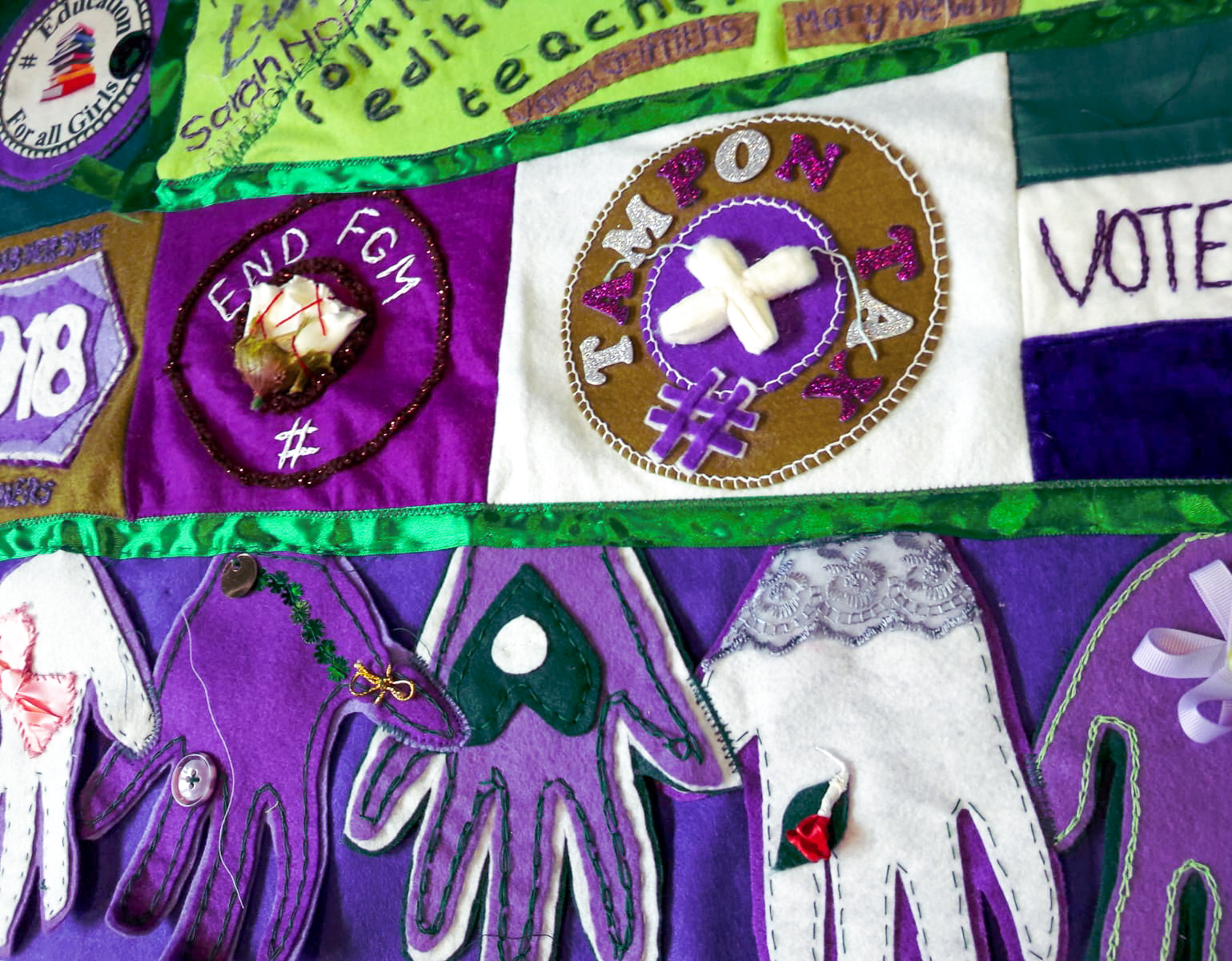
In Shropshire, DASH worked with artist Anne Marie Lagram to develop a programme of inclusive textile workshops for women. Working in partnership with The Hive, SAND, Participate Artspace, Quatt Village Hall and Forge Urban Revival, the project brought women together through making and the Shropshire Subversive Stitchers were born. More than 100 women and girls contributed to the Women Of Shropshire: We Are Here banner, bringing their own words, names, stitched shapes and experiences to the cloth. Anne Marie was the lead artist, guiding the making of the banner across the different groups, while I joined as a support artist to help bring their contributions together. DASH's commitment to accessibility and working with different communities was an important part of the project, and something I have continued to value in my own community textile practice.
Anne Marie divided the banner into sections so that women in different community settings could contribute without everyone having to travel to Shrewsbury. I began to understand how important that practical approach was. A national invitation could become something local and manageable, with each group able to put its own marks and words into the making. Those separate pieces would eventually come together, but they didn't have to begin in the same room.
Getting Under The Sewing Machine | Assembling The Shropshire Banner
When the contributions came back together at DASH, I helped assemble the enormous Shropshire textile banner. I'd never used the type of sewing machine provided before and struggled at first to get used to it. Using free machine embroidery, I joined the separate sections that women and girls had made during the community workshops. The sheer size of the work presented its own challenges, with the fabric stretching across the table and spilling onto the floor. Some areas were impossible to reach with the machine, so hand stitching was needed. At one point I had to sit on the banner itself, on top of the table, because there was simply no other way of reaching the sections that needed stitching.
Working with all these individual pieces, I wanted to preserve the identity of each contribution while giving the finished banner the strength and shape it needed to be carried. The purple and green hills, stitched names, circular details and little hands around the edges had been created by many different women and girls. My role was to help bring their work together, rather than claim the banner as my own.
I also stitched DASH's name and the date, 5 June 2018, onto the back. Photographs show the lettering, the green fabric laid out during construction and me working at the sewing machine. These may seem like small practical details beside the finished banner, but to me they reveal something essential about community textile making: the often unseen work involved in helping individual contributions become something that can travel together.
Boundary Way Allotments & The Growing Together Banner
Anne Marie took me to Boundary Way Allotments & Community Garden in Wolverhampton, where I worked alongside women from the allotment community on a smaller banner for PROCESSIONS. We gathered in the polytunnel, and folklore, storytelling and conversations became part of our time together as we made. The banner celebrated women who had worked the local land, with individual textile 'plots' brought together on a hessian background to reflect the allotments. Across the finished work were the words 'Growing Together' and 'Wolverhampton', connecting the cloth to the place and the people who had contributed to it. This was a very different experience from assembling the enormous Shropshire banner at DASH, with the conversations and shared making becoming just as important to me as the finished textile. On 10 June 2018, I carried the Boundary Way banner through Cardiff as part of PROCESSIONS. I have photographs of us holding it and another of me outside Cardiff City Stadium, wearing sunglasses and a white suffrage sash. Looking at those photographs now, I can see a connection between the time spent together in the polytunnel and the experience of carrying something we had made into a public procession alongside thousands of other women.
PROCESSIONS Cardiff 2018 | Carrying The Banners
On 10 June 2018, 27 of us travelled by coach to Cardiff, according to DASH's project report. We were women from different backgrounds and experiences, drawn together through making and carrying the banners. Some were dressed in full suffragette costume, adding to the sense of occasion. Outside Cardiff City Stadium, women were gathering with banners from communities across the country. The sun was shining, with purple, white and green appearing everywhere in the crowd. There were television crews, conversations and an extraordinary variety of ways in which women had chosen to make themselves visible. DASH recorded around 10,000 women taking part in the Cardiff procession, and it was quite something to find ourselves amongst them.
I carried the Boundary Way Growing Together banner, while the Women Of Shropshire: We Are Here banner was carried alongside us. After all the hours spent stitching, talking and bringing individual contributions together, it felt very different to see those pieces of cloth moving through the streets of Cardiff. Each banner represented the work and experiences of the women who had made it, and seeing them all together gave those earlier workshop hours a much greater sense of purpose. We had come from different places and circumstances, but on that day we were walking together, carrying something that connected us. For me, there was a sense of enormous potential in that feminine energy, in kindness, cooperation and the way we worked together to make change. I felt proud to be a woman.
Seeing The Work Again In London
The story didn't stop when we got home. In August 2020, as an Artichoke Heart, I received a copy of Artichoke's book about PROCESSIONS and was delighted to see the Shropshire banner featured in its pages. There was something important missing, though. Each link in the stitched chain had been made by a woman from Shropshire, and we had carried the chain on our backs through Cardiff so that women who couldn't travel could still be represented. I couldn't find that part of the work in the book, and felt it deserved to be remembered. I wrote about it in my blog post, Women Of Shropshire: Women Making History, which also includes my photograph of the book. In 2021, I visited Artichoke's 'Women Making History' exhibition at London Scottish House, where I encountered the Shropshire banner again. No longer travelling through the streets, it was displayed so visitors could look closely at the stitching and the contributions of its many makers. I photographed myself beside it, remembering the hands, conversations and shared work that had brought it into being.
The Cloth Continued Into Other Projects
Artichoke later donated unused suffrage coloured sashes from PROCESSIONS, and I couldn't bear to see perfectly usable cloth go to waste when there was still so much potential in it. Rather than saving the fabric for one particular purpose, I began finding different ways for it to have another life. During lockdown in 2020, I also used some of the sheer purple sash fabric to stitch the words 'Space To Breathe' for Common Threads Project's #GivingTuesday appeal. I filmed the ribbon in support of the charity's work, discovering another way for these materials to carry messages of care and connection beyond their original purpose. Some became part of Sew What?, my first Arts Council England funded project in 2021, where women stitched their own words and experiences into materials originally intended for a national celebration of women's political history. The cloth also found its way into the Coventry Banner, while other pieces were used in the two banners I made with students at King Edward VI College in Nuneaton for 'Coventry Moves', the opening event of Coventry UK City of Culture. I incorporated the fabric into my own artwork too, and gave some of the sashes to Daniel Lismore, who used them in a mannequin he created for City of Culture. Looking back, I find it fascinating how much can grow from recognising the possibilities in resources we already have. These materials passed between different people and projects, carrying their history with them while becoming part of something new. I can now see this as one of the first clear examples of how I wanted to work as an artist, making use of what was available, sharing resources and recognising their potential rather than always starting with something new. These were ideas I would later bring together in my Manifesto, giving words to an approach that had already begun to develop through my experiences.
Anne Marie also became a continuing mentor, encouraging me and helping me think through my practice and Arts Council applications. I went on to support Artichoke through Artichoke Hearts and to engage with later work such as Sanctuary in Bedworth. For me, those relationships are just as much part of the legacy as the banner itself. The people you meet through one project can continue to shape what happens next, often long after the event and its funding period have ended.
The Mycelium Of A Practice
I've always found it difficult to say exactly where one project ends and another begins. Looking back at PROCESSIONS, I can recognise the beginnings of what I now describe as my mycelium way of working. It wasn't something I had planned or even had a name for in 2018, but the connections were already beginning to grow. Through the people I met, the conversations we shared and the opportunities that followed, I started to understand how much could develop from being open to working alongside others. Sometimes those relationships led to another project, sometimes they brought friendship, encouragement or an unexpected opportunity, and occasionally something I'd experienced years earlier would suddenly become relevant again.
Years later, while working at the Herbert Art Gallery and Museum during the Turner Prize in Coventry in 2021, I discovered that Array Collective had included a banner they had made for PROCESSIONS in their installation. I photographed it, fascinated that here was another connection to the same extraordinary national artwork I had been part of in Cardiff three years earlier. Array's banners were being used to express political and social messages, bringing collective voices into a major contemporary art exhibition. Seeing their work, and recognising our shared connection to PROCESSIONS, helped me understand the continuing potential of banners as a form of public expression. That experience became part of the thinking behind the Coventry Banner, which I went on to develop as a community legacy project inspired by Array. Looking back, I can see how an experience from 2018 had unexpectedly become relevant again in 2021, connecting artists, people and ideas across different places and circumstances.
PROCESSIONS was produced by Artichoke, commissioned by 14–18 NOW and based on an idea by Darrell Vydelingum. In Shropshire, DASH worked with its community partners to bring women and girls together through inclusive textile workshops led by artist Anne Marie Lagram. The women who contributed to the banner became known collectively as the Shropshire Subversive Stitchers, creating 'Women Of Shropshire: We Are Here' through their individual and shared contributions. I joined as a support artist, helping assemble the separate sections into the finished banner. The accompanying film provides another record of this extraordinary collective project.


