


From Front Garden Flax To Public Making | Can Derbyshire 'Makes'?

Updated: Sep 16
Learning How To Grow, Spin & Share Flax Through Community Textile Practice
As a contemporary community textile artist based in Derbyshire, I was recently awarded an Arts Council England National Lottery Project Grant to support a new period of research and development exploring flax growing, hand spinning and weaving through a project titled Irregular Thread. Rooted in participation, sustainability and collective acts of making, the project is gradually exploring whether contemporary textile practice can also help nurture much needed civic pride and connection within post industrial communities.
At the centre of this research and development is a simple but increasingly important question:
Can slower, lower impact and more accessible textile processes still hold value within communities today?
This project is not only about learning to spin or weave, but also about researching materials, tools, and ways of making that might later support workshops, public activities, and wider participation within Amber Valley and beyond. At the heart of the project is a desire to bring the flax growing I have been developing within local front gardens full circle into woven outcomes, reconnecting people not only to material and process, but also to place, heritage and one another through collective acts of growing, making and learning together.
Alongside this practical development, I committed to documenting the process openly on my blog and social media, allowing the work to evolve in public rather than behind closed doors. As my studio is often my front garden, I am already used to being visible whilst I experiment, learn and develop ideas in public view. In recent months, the project has gradually moved from quiet experimentation into public conversation through flax growing, spinning research, live demonstrations and shared making activities.
As the work develops, it is also being shaped by broader questions about connection, civic pride and collective identity within post-industrial communities. Documenting the process while still learning feels important to the project's direction, allowing space for conversation, uncertainty, and exchange rather than presenting myself as an expert with fixed answers. Through revisiting overlooked textile histories and shared acts of making, I have become increasingly interested in whether gentle, accessible, and participatory creative activity might help rebuild forms of connection that feel urgently needed at a time when many people feel increasingly disconnected from one another and the places they live in. Working within an area where economic challenges and historically lower engagement with arts and culture remain visible has also reinforced for me how important it is to develop thoughtful, carefully researched and genuinely accessible forms of creative engagement that feel relevant, welcoming and meaningful within the communities they are intended to serve.
From the beginning, my manifesto has underpinned the decisions I am making throughout this process. It commits me to working with kindness, carbon sensitivity, locality, adaptability and active listening while minimising waste and unnecessary consumption through low-impact approaches.
Rather than separating environmental thinking from creativity, I am trying to understand how the two can work together through material choices, process and participation.
Growing Flax In My Front Garden In Derbyshire
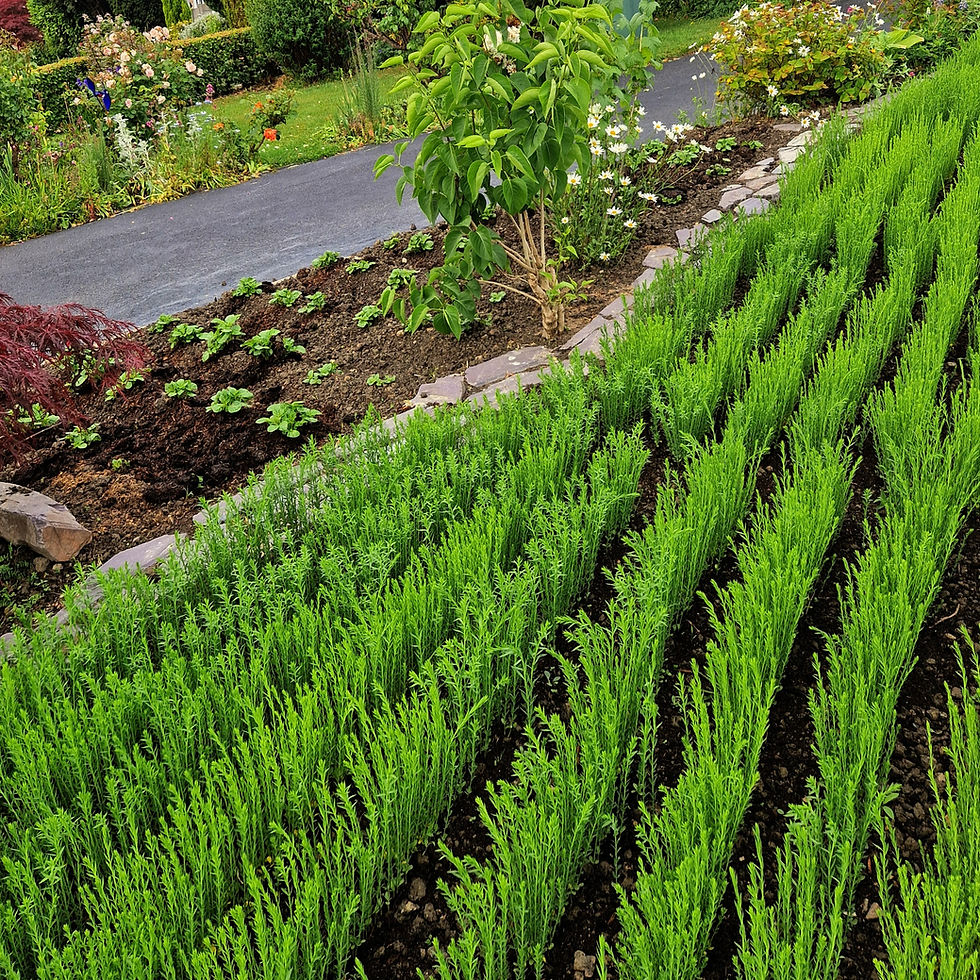
Much of this research begins in the front garden of my home in Riddings, where I am now growing flax for a third consecutive year. What began as a small personal experiment inspired by walking around the former colliery site at Waingroves and discovering its forgotten rope walk has gradually become central to my contemporary textile practice, with the front garden increasingly operating as both growing space and public facing studio. Because the work takes place in full view of the street, the flax has slowly become familiar within the neighbourhood itself, often leading to conversations with neighbours and passers by curious about the delicate blue flowers appearing amongst an otherwise ordinary front garden setting.
Over time, I have worked to improve the heavy clay soil through low-impact methods after years of the ground being treated with weedkiller and left largely lifeless. In the beginning, the soil felt compacted and difficult to work with, so noticing worms returning and strands of mycelium gradually appearing beneath layers of cardboard and mulch has felt quietly significant. These changes have become part of the wider thinking within the project, connecting regeneration not only to the environment but also to questions around care, repair, and what might happen if growing, making, and textile knowledge returned more visibly to everyday life.
Increasingly, the mycelium itself has also become a quiet metaphor within the project. It has led me to think about whether forms of community connection can also be gently grown through small acts of participation and exchange that slowly spread outward over time. My approach within the project is intentionally quite hands-off. Rather than forcing engagement, I am more interested in offering opportunities and allowing them to develop organically through curiosity, conversation and participation. If I gift someone flax seeds, will they grow them, harvest the seeds they produce and pass them to a neighbour who might continue the cycle? If I offer skills in flax processing, cordage, spinning or weaving, will those skills travel outward into wider circles and communities through shared learning and exchange? Like improving the soil itself, these forms of connection cannot be rushed and may take years to establish, strengthen and thrive.

Living and working within Derbyshire's post-industrial landscape has also shaped the project's direction. The area once had a rich and nationally significant history of flax growing and processing centred around Ripley, yet many of these stories now feel largely forgotten in everyday community memory. Historically, industry has connected many communities through shared labour, production, and collective purpose, and I have become increasingly interested in whether materials such as flax might still offer opportunities for people to reconnect through slower, more accessible acts of growing and making together. At a time when many people feel increasingly disconnected from both place and one another, these small acts of participation and exchange can feel quietly important.
Flax continues to draw me in because it is such a gentle plant. Historically, flax and linen sat quietly within everyday life across many cultures worldwide, yet today many people have little connection to where cloth begins or how fibre behaves before industrial processing. Growing flax at home has made me increasingly aware of how distant modern textile production can feel from land, labour and locality, while also raising questions around our dependence upon industrial systems and environmentally costly forms of production.
Rather than recreating the past for nostalgia's sake, the project is gradually becoming an exploration of which forms of knowledge, care and collective making might still hold value within contemporary life. Again and again, I find myself returning to the possibility that something as ordinary and gentle as flax still has the ability to bring people together through curiosity, conversation and participation.
Learning To Spin Home Grown Flax
Alongside growing my third crop of flax to produce enough material for future community events, I have begun developing introductory hand spinning skills through intensive practical learning, experimentation, and repeated engagement with the fibre itself. From the beginning, part of the research involved openly acknowledging uncertainty within the work. I already understood that home grown flax would likely behave very differently from commercially prepared fibres and that learning to work with these materials would require far more patience, repetition and bodily familiarity than simply purchasing a consistent manufactured yarn.
Before moving on to spinning itself, much of the early research focused on learning to handle and understand flax through repeated experimentation with retted stems. I began by cracking stems by hand to reveal the fibres within, gradually learning how much pressure was needed, how differently individual stems could behave, and which movements consistently helped separate the fibre from the plant material. Some stems released easily, while others resisted, snapped unexpectedly, or exhibited very different fibre qualities depending on their thickness, retting, and growing conditions.
The root end of the flax often offered very little usable fibre relative to the force required to remove the shive cleanly, so over time, I simply began snapping those sections off between my fingers or trimming them with scissors rather than trying to force the fibre to behave differently. The tip end responded very differently again, often becoming finer and more fragile. Eventually, I stopped trying to control every fragment. If parts naturally dropped away during handling, they dropped away.
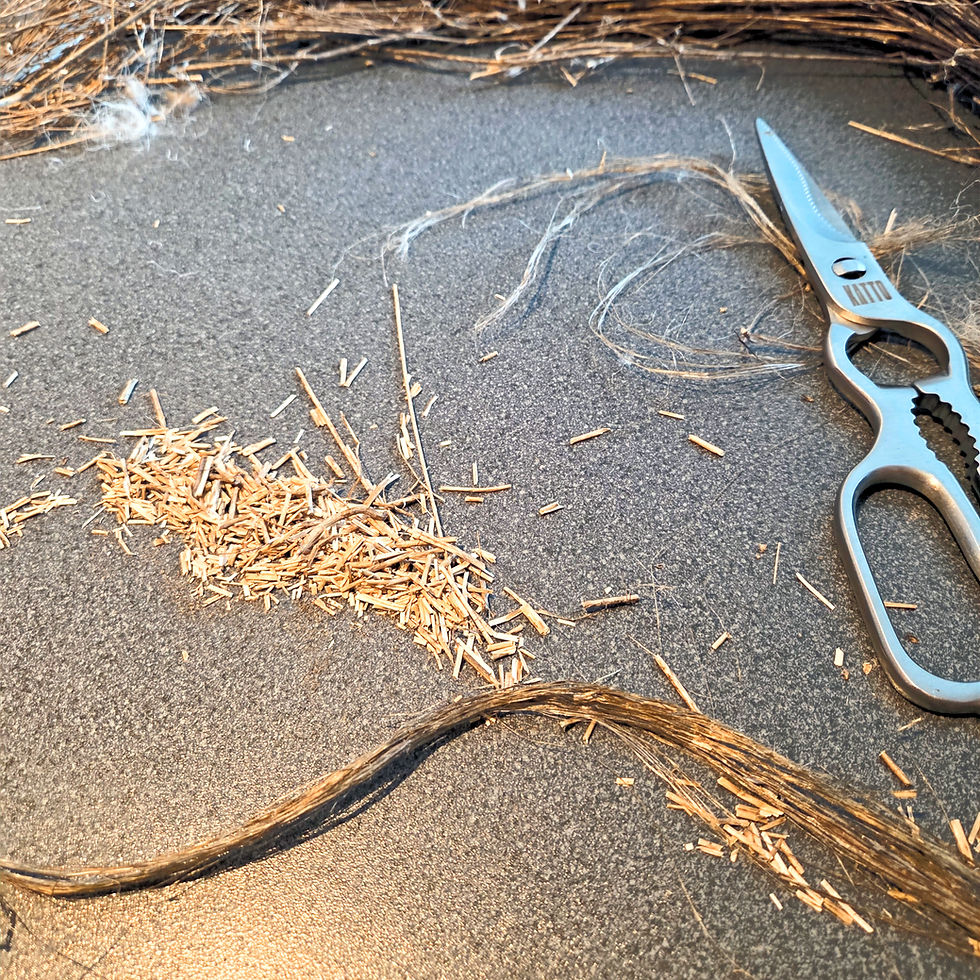
Over time, repetition itself became important. Rather than looking for a perfectly controlled method, I wanted to build a more instinctive understanding of the flax through touch, sound, resistance and movement. Developing a repeatable approach that could work across most stems gradually became part of learning how to read the fibre itself. In many ways, this stage of the project felt less like manufacturing and more like becoming familiar with the flax's behaviour and character.
As the movements became more familiar, I also began translating parts of the learning into simple written instruction sheets to test how these methods might be shared later in workshops and public settings. Breaking the actions down into accessible stages forced me to think more carefully about what was actually happening within the fibre and which parts of the learning were genuinely transferable through demonstration and repetition. Writing the instruction sheets also revealed how difficult it can be to fully explain tactile knowledge through words alone, reinforcing how much embodied understanding sits within touch, rhythm and repeated contact with the material.
Following the initial flax cracking experiments, I began making cordage by hand to better understand how the fibres behaved once twist and tension were introduced. This stage of the research became less about producing finished outcomes and more about observing how the flax responded through repeated movement and touch. I experimented with how many flax stems were needed to create a usable cord thickness, how tightly or loosely the fibres could be twisted before weakening, and which hand positions, movements, and tensions produced the most stable and repeatable results.
Little by little, the movements became more intuitive, with small adjustments in finger placement, rhythm and tension making significant differences to the strength and behaviour of the cordage itself. Some approaches immediately felt awkward or overly complicated, while others naturally simplified the activity and made it easier to repeat consistently. Again, I found myself drawn towards methods that felt accessible, adaptable and achievable without specialist tools or expensive equipment.

Finding ways to work with flax that require minimal cost, skill, or equipment remains very important to the project's broader direction. If these approaches are eventually going to move into public workshops and community settings, they need to feel welcoming, achievable and transferable rather than technically intimidating or financially out of reach.
Making cordage by hand also repeatedly brought me back to the original inspiration for the project: discovering the forgotten rope walk at the former Waingroves colliery site. There was something quietly significant about standing in my front garden, twisting fibre by hand whilst thinking about the physical repetition, labour and skill that once existed within the area's industrial landscape. In many ways, the cordage began to feel like a small contemporary echo of those overlooked local histories, reconnecting hand, fibre and place through repeated acts of making.
Part of the thinking behind this approach also comes from the work of Harriet Goodall, whose teaching around natural cordage and plant materials first opened up new ways of considering skill sharing, storytelling, and place-based making. I have been particularly drawn to the way she combines practical knowledge with conversations around local history, material significance and cultural memory, allowing it to become a way of reconnecting people to landscape, heritage and one another through shared experience. As I developed my own flax cracking and cordage methods, I found myself consciously drawing on aspects of this approach, thinking carefully not only about the physical processes themselves, but also about how the work might later be shared within community settings in ways that feel welcoming, meaningful and rooted in place.
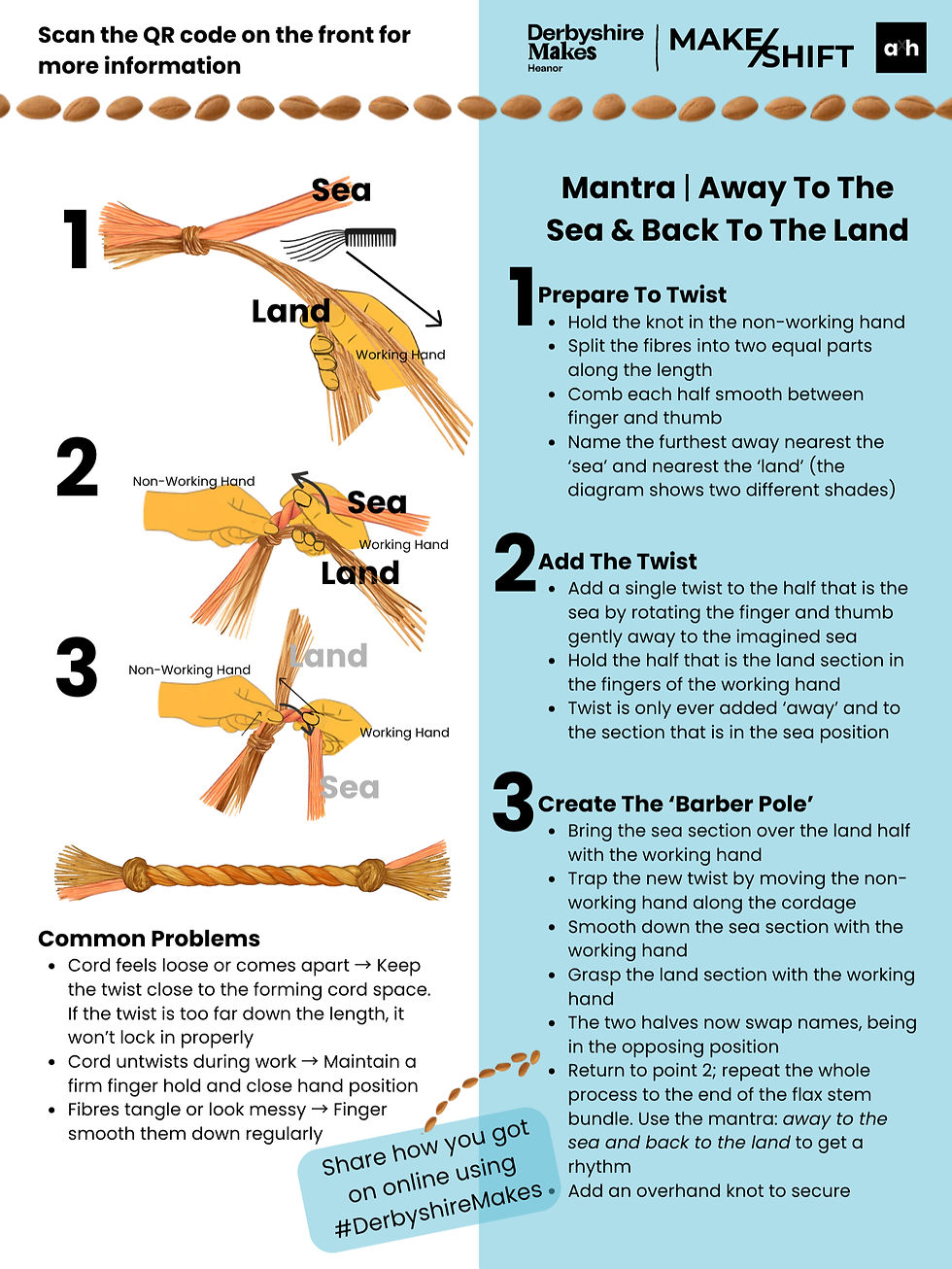
Slowly, both flax cracking and cordage making began to take on an unexpectedly meditative quality. Once the bodily coordination became more understood, the repetitive rhythm of cracking stems, separating fibre and twisting cordage by hand created long periods of focused attention and quiet concentration. In many ways, the activity seemed to encourage slowness, patience and presence in a way that felt increasingly at odds with the pace and distractions of contemporary life. As with the flax cracking research, I also translated parts of the cordage making into a simple community instruction sheet. Breaking the method down into clear stages continued to deepen my own understanding whilst also testing how these forms of tactile knowledge might later be shared more widely through collective learning and public participation.
Only after spending considerable time understanding flax through hand processing and cordage did I begin moving towards spinning wheel work itself. Although I was originally trained within industrial textiles, I had never worked through this kind of direct hand application or physically embodied relationship with fibre. Working with flax in this way has therefore felt very different from my earlier textile education, requiring patience, repetition and a much slower form of understanding developed through touch and handling rather than industrial systems or machinery alone. Part of this learning took place with Diane Fisher at Masson Mills. Diane regularly shares her spinning knowledge and specialist expertise with artists, universities, heritage organisations and wider communities across the UK, often supporting projects through teaching, demonstrations and spinning on behalf of others. We began with wool rather than flax itself, with Diane carding the fibre into slugs to make it easier to draft and learn from, before gradually moving on to experimenting with flax fibres later in the day.
There was also something particularly significant about learning at Masson Mills itself, one of Derbyshire's most historically important textile sites associated with Sir Richard Arkwright and the mechanisation of spinning during the Industrial Revolution. Sitting within the former manager's office, surrounded by spinning wheels whilst learning these slow hand techniques beneath a portrait of Arkwright, created a strange and powerful contrast between industrial textile history and this much more intimate, tactile and imperfect relationship with fibre by hand.
Although I arrived at Masson Mills with a background in industrial textiles, I quickly realised that I could not simply move straight into spinning itself. My traveller spinning wheel was completely new to me, as was using any spinning wheel at all, and one of the first things I began to understand was that every wheel has its own feel, rhythm and small idiosyncrasies.
Before I was even capable of consistently spinning fibre, I spent long periods simply treadling the wheel to develop a sense of the pressure, rhythm, speed, and coordination required. At first, trying to coordinate both hands and feet simultaneously felt almost impossible, strangely similar to learning to drive a car, where different parts of the body are all attempting separate tasks at once. I quickly realised I could not focus on drafting fibre and controlling the wheel together until some of the treadling movement itself became more instinctive.

Diane carefully explained the individual parts of the wheel and their different functions, while also helping me understand how to adjust and troubleshoot the particular quirks of my own wheel. In reality, spinning itself did not begin until quite late in the morning because much of the learning initially involved becoming familiar with the mechanics, movement, and bodily coordination involved. What surprised me most was how quickly progress could disappear again. After lunch, I felt completely rubbish again, as though everything I had briefly understood in the morning had disappeared. More than anything, the experience reinforced how much spinning relies on repetition, bodily memory, and repeated engagement rather than on intellectual understanding alone. Another thing I quickly became aware of was just how hard I was physically trying to force the spinning to work. My whole body rocked backwards and forwards as though I could somehow will the twist into behaving properly through effort alone, with almost every muscle engaged in concentration and tension. Meanwhile, Diane sat calmly treadling away beside me in complete contrast, relaxed and effortless in her footsies.
I found myself repeatedly having to consciously tell my body to relax. In the end, one of the only things that genuinely seemed to help was pretending. I began acting as if I already knew how to spin, mimicking what I imagined an experienced spinner might look and feel like physically. Somehow, fixating on the image of Rapunzel and briefly attempting to become her helped everything soften, settle, and flow more naturally through my hands. Eventually, things did begin to improve once I started working with wool more confidently. As some of the coordination settled slightly into muscle memory, it became easier to focus on drafting fibre rather than simply trying to keep the wheel under control. Only then did we begin moving back towards experimenting with the homegrown flax fibres I had brought with me.
Because the flax behaved very differently from the prepared wool, Diane began experimenting with ways to make the fibres easier to draft into a single-ply yarn. One of the most useful discoveries involved shortening the fibre length by cutting the flax with scissors before carding it again into a slug. This immediately changed how the fibre behaved in the hands, making it easier to draft and control through spinning.
Small physical positions and movements also began to feel increasingly important within the learning itself. One of the key things I needed to remember was the triangular positioning of the fingers on my right hand, gently fanning the fibres outward into a soft V shape whilst the left hand held the twist in place. Tiny shifts in angle, tension and hand placement could completely alter how the fibre travelled through the hands, making the spinning feel surprisingly sensitive and responsive. By the end of the day, I had only managed a small amount of flax spun into a single ply yarn, but even that felt significant. More than anything, the experience made me realise that the rest of the journey will largely come down to practice, patience and repeated engagement rather than expecting quick mastery. I left feeling encouraged, whilst also fully aware that a large part of the process ahead will involve persistence, gradual bodily learning and, ideally, resisting the temptation to lob the spinning wheel out of the window.
More than anything, the experience reinforced that this research is not really about mastering perfection but about developing a slower, more attentive relationship with fibre, labour and making through patience, repetition and continued practice. The irregularities within the flax no longer feel like problems to be removed, but rather traces of process, place, and ongoing learning.
Continuing The Research
This project remains very much in development.
Increasingly, I am beginning to understand that this research is not really about achieving technical perfection or forcing the flax into uniformity, but about learning how to work with the material as it actually behaves through repeated handling, adjustment and practice. Many of the irregularities within the fibre that I might once have viewed as mistakes now feel far more valuable as visible traces of place, weather, touch and process.
What has surprised me most throughout this stage of the project is how physical and embodied the experience has been. Progress has rarely arrived through thinking alone, but through rhythm, repetition, frustration, coordination, and gradually becoming more familiar with both the fibre and the spinning wheel itself. The work continually returns me to touch, movement and attentiveness, reminding me that some forms of knowledge can only develop slowly through repeated contact with the fibre itself.
Working with flax in this way from my Derbyshire front garden whilst researching local textile histories and gradually beginning to share aspects of the process publicly has also made me think differently about value, skill and participation within contemporary textile practice. Rather than arriving neatly at mastery, the project currently feels much more like the beginning of an ongoing relationship with fibre, place and shared making that will continue evolving through further experimentation, community participation and collective learning.


