


Flax & Linen In Florence | Finding Linen In Renaissance Art

Updated: Sep 16
I am in Florence on holiday, but it turns out that when you spend your time growing flax and thinking about linen and textile heritage in Derbyshire, you do not easily switch that way of seeing off. So I set off on an unplanned adventure to discover flax and linen in Renaissance art and across Florence, if it was indeed there.
Like most visitors to Florence, I went to the Galleria dell 'Accademia expecting to see Michelangelo's David. The gallery was crowded, and people gathered around the marble figure, cameras raised, voices echoing through the space.

Yet the moment that stayed with me most in Florence was not made of marble at all. It was upstairs.
Tucked away on the first floor was a fourteenth-century embroidered altar cloth that honestly made me say 'wow' out loud. I probably spent longer standing in front of that textile than anything else I have seen in Florence so far. The piece, Coronation Of The Virgin With Eight Angels & Fourteen Saints, was made in 1336 by the Florentine embroiderer Jacopo Cambi for the church of Santa Maria Novella. An embroidered inscription records the maker and date: 'Jacobus Cambi de Florentina me fecit MCCCXXXVI.' I'd found linen in Renaissance Art.

Seen up close, the cloth is extraordinary in scale, roughly four and a half metres across and just over a metre high. It would originally have stretched across the front of the high altar as an altar frontal, forming a rich visual surface beneath the table during the liturgy.
At the centre is the coronation of the Virgin Mary, surrounded by angels and saints worked in silk and gold thread. Along the upper border runs a sequence of smaller scenes from Mary's life. The whole composition unfolds across the linen ground like a painted altarpiece translated into thread. Standing in front of it, it becomes easier to imagine how it might once have appeared in its original setting, catching candlelight as the gold thread flickered during the mass.
At first glance, the textile dazzles with gold and colour. What held my attention, though, was something quieter.
The foundation cloth is linen.
And linen begins with flax.
Before it became linen, this cloth began as flax growing in a field.
Looking Closely At Linen In Renaissance Art

Because I am currently working with flax through my Beneath Our Feet project in Derbyshire, I have found myself studying the embroidery's surface very carefully.
From a distance, the faces almost appear painted. Leaning closer, I zoomed in with my camera and began to see the tiny stitches that formed them. What had first looked like brushwork resolved into thousands of incredibly small stitches worked with remarkable precision.
Looking at them through the camera lens, it was hard not to think about the hands that made them. Stitches this small must have required extraordinary patience and steady eyesight, worked long before electric light existed, likely in daylight and candlelight, and without the magnification we rely on today.
In places where the gold thread had worn away, the structure beneath the embroidery became visible. The metal thread had been laid across the linen and stitched down using couching. Where the gold had disappeared, a simple cord beneath it was revealed again.
Gold thread like this was often made from thin strips of gold or gilded silver wrapped around a core thread, sometimes silk, sometimes linen. Rather than passing through the cloth, it was laid on the surface and secured with tiny stitches. Over time, as the metal wears away, the structure beneath begins to show itself.
It is quite possible that the cord now visible in the worn areas was also made from flax fibre.
Seven centuries of use had quietly exposed the structure of the textile.
The decoration fades first, leaving the fibre beneath to tell the story.

Linen provides a strong, stable ground, capable of supporting dense embroidery and heavy threads while holding its form over time.
Listening To The Story Behind The Cloth | Flax & Linen In Florence Explained
While I stood studying the cloth, a member of the museum staff came over, and we began talking about it. They told me that many visitors pass quickly through the gallery after seeing David, and that pieces like this can easily be overlooked.
They also explained how rare such textiles now are. Many altar cloths once existed, but very few survived. They were used, handled, folded, and worn. Gold threads could be removed and reused. They were not always seen as artworks to be preserved, but as objects within a living practice. Yet their presence remains in another form.
The staff member pointed out that altar cloths appear again and again in frescoes and painted religious scenes. Once I had been told this, I began to notice them myself, first in a wooden altar panel in the same gallery, and then as I moved back through the space, in other works I had not seen in that way before.

The sophistication of the embroidery also suggests that a painter may have been involved in the design. In medieval workshops, it was common for painters to create detailed drawings that embroiderers would translate into thread.
These were collaborative works. Painters, embroiderers, dyers, spinners, growers. Looking at the cloth, it becomes difficult not to think about the many hands that must have contributed to its making.
Learning Where To Look
Earlier in the week, I had visited the Uffizi Gallery. At the time, I had been looking at the paintings in the usual way, noticing faces, composition and colour.
After my conversation in the Accademia, something shifted. I realised I had already seen these textiles before. I had walked past them without seeing them.
Returning in my mind to the paintings, I began to remember the draped fabrics that appear again and again, cloth spread across tables, hanging behind figures, folded and falling in careful lines. Once I started looking for them, they seemed to be everywhere.

At the Uffizi, something else began to shift in how I was seeing. I stood in front of Primavera by Sandro Botticelli, and found myself drawn not just to the figures, but to the dress of Flora, covered in an extraordinary scattering of flowers. They are not decorative in a loose sense. They are precise. Observed. So carefully rendered that botanists have studied them and named the species.
It is a kind of attention that borders on devotion.
And yet, standing there, I realised something.
For all this care, all this looking, all this recording of the natural world, flax is not there. A plant that sits at the heart of cloth. A plant that becomes linen. A plant that holds labour, process, time, touch. Absent.
It stayed with me, because I had already begun to notice the textiles in the paintings, the folds, the weight, the suggestion of linen behind the figures. But until someone had pointed it out to me, I hadn't really seen them.
Now I couldn't unsee them.
And yet even here, where flowers are named and studied, the material that carries so much human effort remains largely invisible.
It made me think about what we choose to notice, and what we allow to remain in the background.
A Conversation In The Duomo
A visit to Florence Cathedral brought that realisation into sharper focus. By then, I was already seeing the city differently, noticing materials rather than just images. While I was there, a guide mentioned that Florentine painters had at some point begun adding oil from flax seeds to their paints. It was a passing comment, but it stayed with me.
Linseed oil, pressed from flax, binds pigment and allows colour to build in layers, creating the depth and luminosity that define so many Renaissance works.
Thinking back to paintings I had already seen, including works such as Leonardo da Vinci's Annunciation, I realised that flax was not only present in the cloth depicted within them. It was present within the paintings themselves.
The same plant that produces linen cloth could also exist invisibly within the surface that holds the image together.
It felt like the plant was following me through the city.
Linen Shops In Florence | Surface & Story

Alongside the museums and churches, I found myself drifting into linen shops across Florence. It almost became instinct. After everything I had seen, I was no longer just looking at paintings or altars, but following the material itself, noticing where linen appeared and how it was presented.
At Le Telerie Toscane, shelves were stacked with beautifully folded household linens, tablecloths, towels, lengths of fabric, all carrying that familiar weight and texture. Florence is known for this kind of linen, and standing there, it felt like a continuation of everything I had been seeing, cloth as something valued, refined, complete.
But it was here, in this shop, that the story shifted.
The woman I spoke to explained that much of the flax used to produce these textiles now comes from Egypt, where longer fibres can be grown more consistently, allowing for finer, more uniform linen. And yet, the linen is still presented as Florentine, designed here, finished here, sold here.
It made me pause, because I began to recognise something that felt closer to home than I expected.
In Derbyshire, the flax industry once held significant importance. At Ripley, flax was processed into fire hoses, into webbing for aircraft, into materials that were essential, functional, and often invisible. There was no softness to the story, no decorative surface, no sense of something to be displayed or desired. It was work, necessary work, and when that industry disappeared, it did so quietly.
Florence seems to have taken a different path. Here, the connection to linen has been held onto, not through growing or processing the flax itself, but through design, finish and reputation. The material may no longer begin here, but the identity around it remains intact, shaped into something that can still be seen, valued and sold.
So I found myself thinking about what survives, and what doesn’t. Both places have lost something, but only one has found a way to keep telling the story.
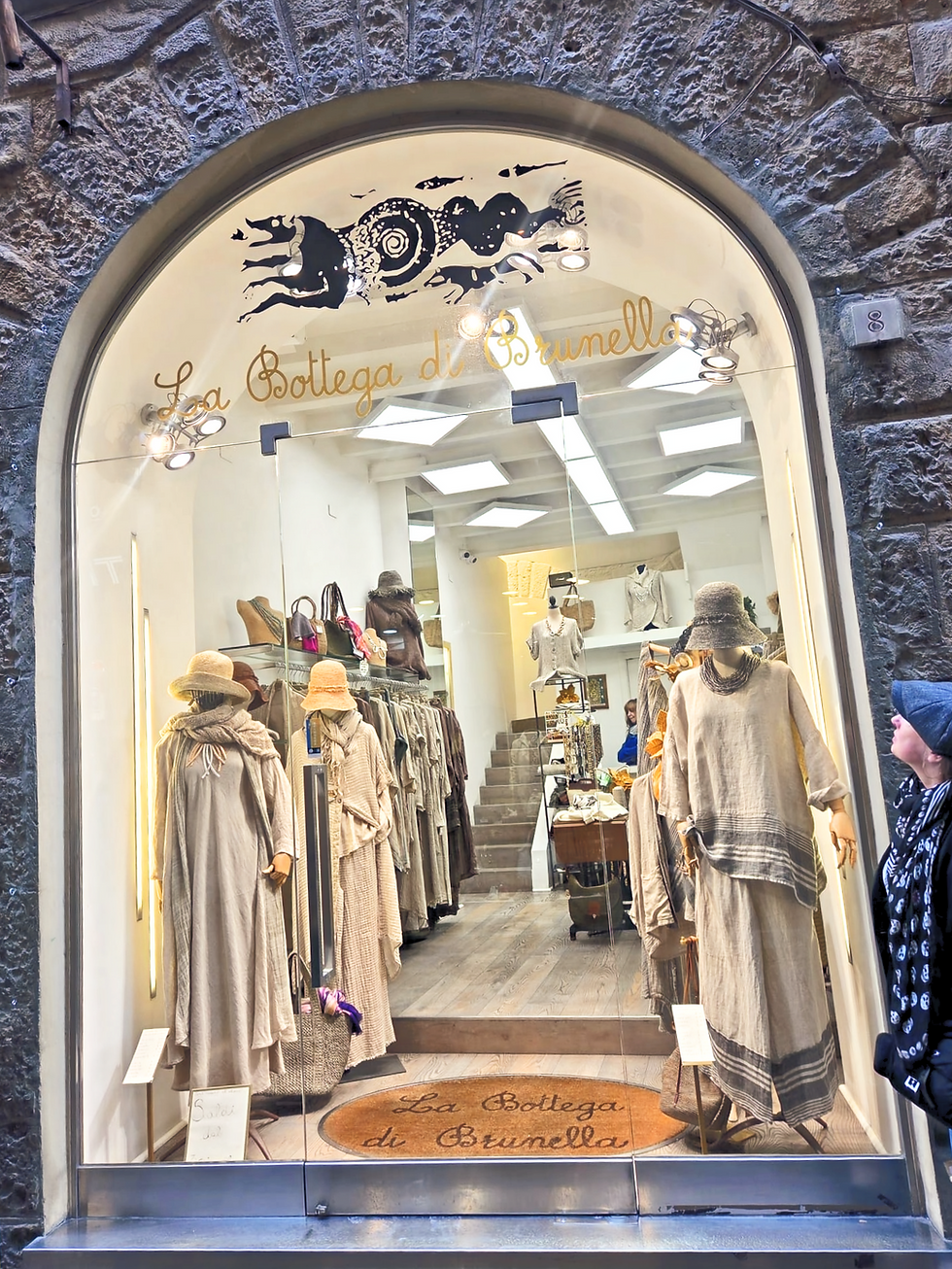
In La Bottega di Brunella, linen is no longer folded and stored, but worn, shaped and lived in. Here, the linen moved differently, softened into clothing and shaped to the body, garments that seemed to carry both structure and ease at the same time. It still felt like a continuation of everything I had been seeing, linen present, valued and desired, but held differently.
In Florence, linen carries a strong sense of textile heritage, of place and tradition, and yet the fibre itself may have grown elsewhere entirely, shaped by different soils, climates and hands. Once again, I felt that familiar pattern returning, where the surface tells one story while the material holds another.
And beneath that, there are people, growers, processors, workers, lives and labour held quietly within the cloth, rarely named, but always present.
It echoed what I had seen in the linen altar cloth, work that holds everything together but is so easily overlooked. And once again, I found myself asking not just what I was looking at, but what I was not being shown.
Returning To The Cloth At Santa Maria Novella
I felt the need to go to Santa Maria Novella to see where the original altar cloth would have once been placed.
By that point, I was no longer just looking at the church as a visitor. I was looking for textiles. Among the many altars, I encountered another altar cloth. Not the same one I had seen in the Accademia, but a sister carrying a similar presence. Nearby were vestments and robes, further traces of how linen moved through the life of the church.

This time, my attention went straight to the construction. Linen ground. Threads laid across the surface. Areas of wear revealing structure beneath. In one section, the stitching had worn enough to expose the linen more clearly. It was impossible not to think about the time held within that surface. Handling, folding, use. The fact that it was never meant to sit behind glass.
But what stayed with me most was something else.

Nearby, I saw a painted image of Christ taken down from the cross, his body wrapped in linen. I took a photograph of it, drawn not to the figure, but to the cloth itself.
Linen here was not decorative. It was intimate. It touched the body. It absorbed. It held.
In that moment, I began to understand something I hadn't fully grasped before. Linen has long carried a quiet sacredness, not because it is rare or luxurious, but because of how it is used. It sits closest to the body, in life and in death. It is present at moments of care, of ritual, of transition. In the Gospels, Christ is wrapped in linen. On the altar, linen sits beneath the Eucharist. In vestments, it lines what is worn closest to the skin. Again and again, it is the material that meets the human body at its most vulnerable.
And yet, despite this, it remains almost invisible.
That contradiction stayed with me as I thought back to everything I had seen over the past few days. The extraordinary linen altar cloth, worked with such precision and labour, tucked away on the first floor while crowds gathered around David. The painted fabrics in the Uffizi, present but unnoticed until someone showed me where to look. The linen shops across Florence, where the cloth is beautifully displayed, but the origins of the flax and the labour behind it are harder to see.
Even in Botticelli's Primavera, where the flowers are so carefully observed that they have been studied and named, flax is absent. A plant that becomes linen, which underpins so much of what we wear and use, is missing from the visual story.
It made me question how we assign value. Linen is useful. It is strong, breathable, capable of holding stitch, of absorbing dye, of lasting over time. It comes from a plant with a delicate blue flower, something both ordinary and beautiful. And yet the material itself, and the labour that transforms flax into linen, often sit outside of what is recognised or celebrated.
Perhaps that is exactly why it became sacred.
Not because it was elevated above everyday life, but because it was embedded within it. Because it was the material that carried, held, and supported without demanding attention. Because it was trusted.
And still, it is so often overlooked.
That tension, between sacred and ordinary, visible and hidden, beauty and utility, began to feel less like a contradiction and more like something I needed to pay closer attention to.
And suddenly, the material I had been following through embroidery and paint became something much closer to human experience.

The vestments nearby carried that same sense of presence. Many would have been lined with linen, a layer that sits closest to the skin, quietly doing its work beneath the more visible fabrics. It is not the part we are meant to see, and yet it is the part that touches the body, that absorbs, that supports, that holds the structure together.
I began to recognise the same pattern repeating itself, not as a neat idea but as something embedded across everything I had been looking at. The outer surface carries meaning, imagery, and symbolism, while beneath it, linen holds it all in place. And beneath that, flax, grown, processed, spun, handled, each stage carrying its own labour.
The more I looked, the more I realised I was no longer just seeing objects. I was seeing processes unfolding through material, and beginning to understand linen not simply as surface, but as something that connects body, ritual and labour in a continuous thread.
Immersion & Emotional Response | From Linen To Rothko
During my time in Florence, I also attended the opening of Rothko in Florence, one of the world's most important Mark Rothko exhibitions. It was shown at the Palazzo Strozzi. People stood quietly in front of the paintings, not rushing, not photographing, but simply staying with them.

Resting in front of Rothko's work, I found it became something other than painting. Large, quiet, immersive, the surfaces seemed to shift as you stood with them, asking you to slow down and stay. Rothko wrote about wanting the viewer to see the world his way. That idea stayed with me.
'It is our function as artists to make the spectator see the world our way, not his way.' | Mark Rothko
I began to recognise the same qualities I had seen in the textiles, realising that this was exactly what the altar cloth had been doing all along. Positioned at the altar, lit by candlelight, worked in gold and colour, it shaped how it was seen. It held attention.
Both relied on surface.
Rothko through layers of colour.
The embroiderers, through silk and gold thread to catch the light, and multiple fabric additions.
Different methods, similar effect.
Looking more closely, I began to think about what those surfaces were made from. Some of Rothko's works are on wove paper, allowing pigment to sink into the surface. Historically, such paper could be made from linen rags. And within the paint itself, flax-derived oil holds everything together.
Again, the same material appears.
Sometimes visible.
Sometimes hidden.
Rothko often avoided descriptive titles, allowing the work to speak for itself. The altar cloths did the same. They simply existed, asking the viewer to meet them.
And yet one is protected, valued, centred.
The other sits quietly upstairs.
Florence & Derbyshire | Flax Then & Now
In Florence, linen moves quietly between worlds. It holds the body, it carries meaning, it supports what is visible while remaining largely unseen. It appears in paintings, in altar cloths, in vestments, in shops, and yet so often it is not named, not pointed to, not fully recognised.
And yet, here, the story has been held onto. Through ritual, through aesthetics, through design, through the ways in which linen continues to be seen, valued and placed in front of us.
In Derbyshire, that story has almost disappeared. The growing, the processing, the making, once essential, now largely out of view. Flax was still grown and worked, but it moved into forms that were purely functional, fire hoses, aircraft webbing, materials that did their job and were never meant to be seen.
That is where the difference lies.
In Florence, linen remained connected to the body, to ritual, to beauty and to meaning. In Derbyshire, it became invisible.
Standing in front of Rothko's work, I was reminded that material can still carry feeling, that something built slowly, layer by layer, can hold a presence that is deeply human and shared.
My thoughts kept returning to flax. To the small blue flower. To the work of growing, pulling, retting, breaking, spinning. To what it means to make something from the ground up, and to do that work in the open, with others.
Perhaps the task is not simply to look more closely, but to bring these materials, and the people connected to them, back into view.
To notice them. To value them. To work with them again.
To bring that story back to the surface, and into our hands, where it can be held, shared and made visible again.


